Suspension Health Assessment Tool
Diagnose Your Suspension System
Answer these questions about your vehicle's behavior to assess suspension health. Select all symptoms you're experiencing.
Suspension Health Assessment
Suspension Health Score
78Good Condition
Your suspension system is performing well. Continue regular maintenance checks every 20,000 km or annually.
Recommended Actions
- Inspect control arm bushings during your next service
- Check shock absorber condition with your mechanic
- Monitor tire wear patterns
Your car doesn’t feel right. It bounces too much over bumps, leans hard in turns, or makes weird clunking noises when you hit a pothole. You’re not imagining it-your suspension might be failing. And if you ignore it, you’re not just risking comfort. You’re risking control, tire wear, and even safety.
What Suspension Parts Actually Do
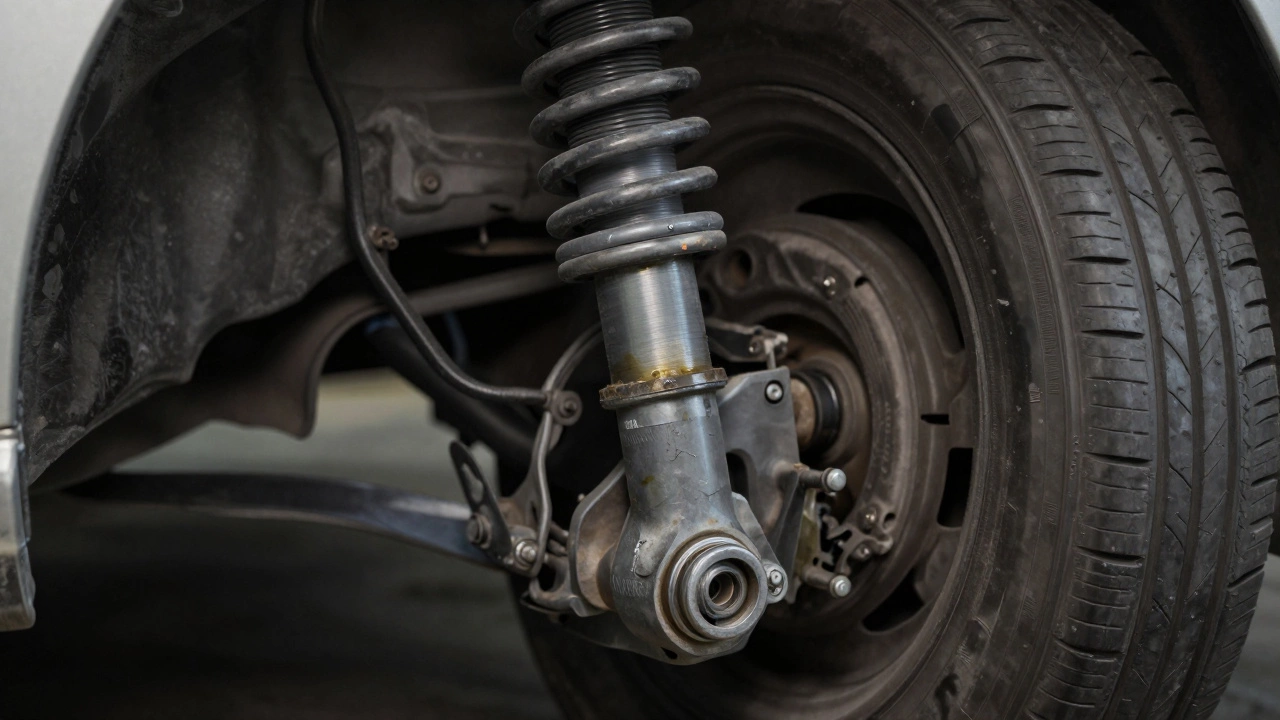
Suspension isn’t just springs and shocks. It’s a system made of several parts working together: shock absorbers, struts, control arms, ball joints, sway bars, bushings, and springs. Each has one job: keep your tires firmly on the road while smoothing out bumps.
Think of it like this: when you drive over a speed bump, your wheels go up and down. Without suspension, that energy would shoot straight into your body. With good suspension, that energy gets absorbed, and your tires stay planted. When parts wear out, that balance breaks.
Signs Your Suspension Parts Are Bad
You don’t need a mechanic to spot early warning signs. Here’s what to look for:
- Excessive bouncing-After hitting a bump, your car should settle in one or two bounces. If it keeps bobbing up and down like a boat, your shocks or struts are worn.
- Uneven tire wear-If you see cupping (scalloped dips) or one side of the tire wearing faster than the other, suspension misalignment is likely to blame.
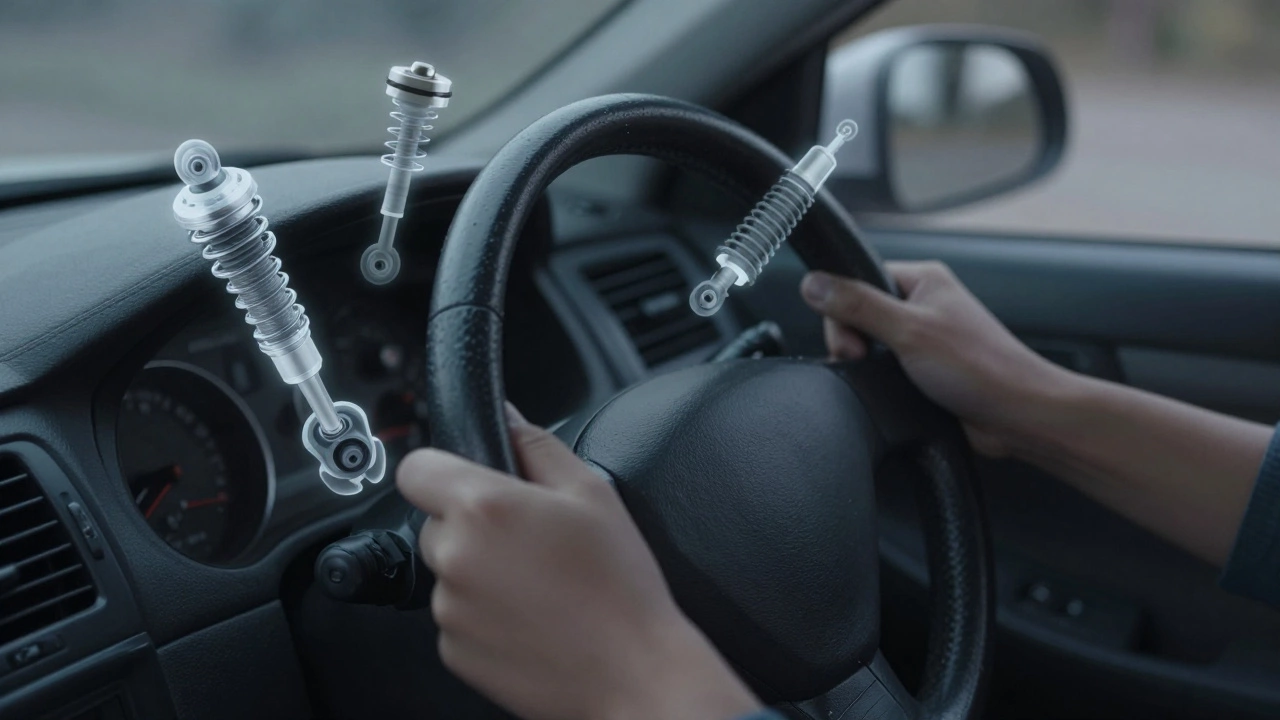
- Steering feels loose or wobbly-If the wheel feels sloppy when you turn, or the car pulls to one side without steering input, ball joints or control arms could be loose.
- Clunking or knocking noises-Hear a loud thud when going over bumps? That’s often a broken bushing, worn control arm, or failing strut mount.
- Nose dive or squatting-When you brake hard, the front end dips sharply. When you accelerate, the rear sinks. That’s a sign shocks aren’t controlling weight transfer anymore.
- Fluid leaks-Shocks and struts are filled with oil. If you see oily residue on the outside of the shock body, it’s leaking and losing damping power.
One real-world example: I had a 2018 Honda Civic come in last year with uneven front tire wear. The owner thought it was alignment. We checked alignment-it was fine. Turned out the lower control arm bushings were cracked and collapsed. The wheel was tilting inward at the top, eating the inside edge of the tire. Replaced the bushings, and the wear stopped.
How to Check Suspension Parts Yourself
You don’t need a lift to do a basic check. Here’s how:
- Do the bounce test-Push down firmly on each corner of the car. Let go. If it bounces more than twice, your shocks or struts are worn.
- Look for leaks-Crawl under the car (or use a flashlight from the side) and inspect each shock or strut. Any oil residue? That’s a leak. Even a small amount means it’s failing.
- Check for play in ball joints-Jack up the front of the car so the tire is off the ground. Grab the tire at 9 and 3 o’clock and try to wiggle it. If you feel movement in the joint (not the whole wheel turning), the ball joint is worn. Do the same at 12 and 6 o’clock-this checks the wheel bearing.
- Inspect bushings-Look at the rubber parts connecting control arms and sway bars. Cracks, splits, or chunks missing? Replace them. Rubber doesn’t stretch forever.
- Check tire wear patterns-Use a penny. Put it head-down into the tread. If you can see all of Lincoln’s head, your tread is below 2/32 inch. But if the wear is uneven-more on one side, or cupped-it’s suspension, not just low tread.
Pro tip: Do this after driving for 10 minutes. Cold suspension parts can hide wear. Heat and movement make problems louder.
What Happens If You Ignore Bad Suspension
Bad suspension doesn’t just make your ride rough. It causes chain reactions:
- Shorter tire life-Worn suspension can eat through tires in half the normal time. A set of tires that should last 60,000 km might be gone in 30,000.
- Increased braking distance-When your car dives forward under braking, weight shifts too fast. Your tires lose grip. Studies show worn shocks can add up to 20% to stopping distance on wet roads.
- Damage to other parts-Loose control arms can wear out steering components. Bad bushings can stress the frame. A failing strut can crack the wheel well.
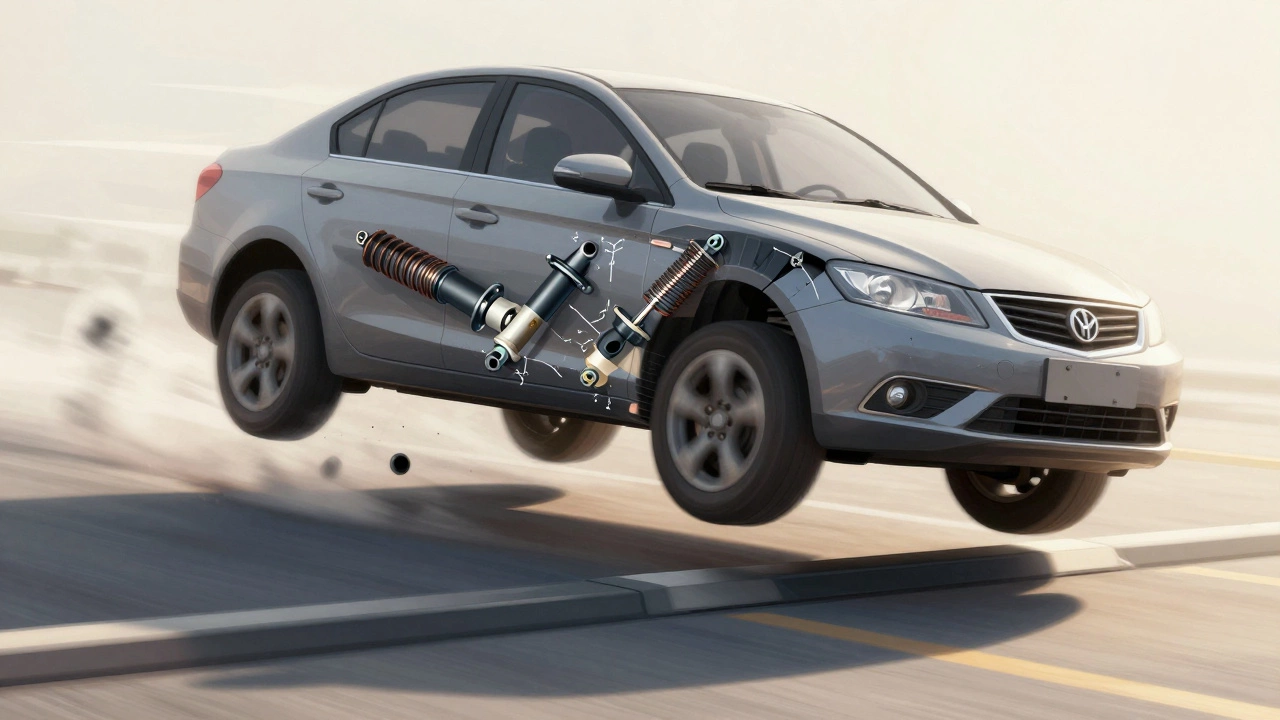
- Loss of control-In emergency maneuvers, like swerving to avoid a deer, worn suspension can’t keep the tires flat on the road. The car might slide or spin.
One mechanic in Perth told me about a crash last year. A driver didn’t realize his struts were shot. He hit a wet patch at 80 km/h, swerved, and couldn’t recover. The car rolled. Suspension wasn’t the cause-but it was the reason the car couldn’t respond.
When to Replace Suspension Parts
There’s no universal mileage. Shocks and struts typically last 80,000 to 100,000 km, but that’s just a guess. If you drive on rough roads, carry heavy loads, or tow regularly, they wear faster.
Replace them when:
- They’re leaking oil
- The bounce test shows more than two bounces
- You see physical damage (bent shafts, broken mounts)
- There’s excessive play in ball joints or control arms
- Bushings are cracked or crumbling
Don’t wait for complete failure. Suspension parts don’t just snap-they fade. The damage builds slowly.
What to Buy When Replacing
Not all suspension parts are created equal. Cheap aftermarket parts might save money upfront but wear out in 20,000 km. Stick with reputable brands like Monroe, KYB, Bilstein, or OEM equivalents.
For most drivers, OEM-quality replacements are the sweet spot. They match factory performance and last longer than bargain brands. If you drive on rough roads or want better handling, consider performance shocks like KYB Excel-G or Bilstein B4.
And always replace in pairs. If one shock is bad, the other is close behind. Replacing just one creates imbalance and makes your car pull or handle oddly.
What to Do After Replacement
After new suspension parts are installed, you need an alignment. Worn parts changed the geometry. New parts won’t fix that-you have to reset it.
Also, take it easy for the first 100 km. Let the new bushings settle. Avoid rough roads if you can. And listen. If you still hear clunks after replacement, something else is wrong. Maybe a mounting bolt wasn’t tightened, or another part failed too.
How Often Should You Inspect Suspension?
Check your suspension every 20,000 km or once a year-whichever comes first. If you live in Adelaide and drive on the city’s older roads or gravel outback routes, check every 10,000 km.
Many people forget suspension until something breaks. Make it part of your annual service. Ask the mechanic to show you the condition of the bushings and ball joints. A quick visual check takes two minutes but can save you thousands.
Final Thought: Don’t Wait for the Noise
The biggest mistake? Waiting for the clunk. By then, you’ve already damaged tires, brakes, and possibly the frame. Suspension wear is silent at first. It creeps up. You just get used to the way the car feels.
If your ride feels off-even a little-don’t shrug it off. Check the shocks. Look at the tires. Do the bounce test. It’s not complicated. And it’s cheaper than replacing a whole set of tires or fixing a bent control arm.
How long do suspension parts usually last?
Most shocks and struts last between 80,000 and 100,000 kilometers, but this depends heavily on road conditions. If you drive on rough, unpaved, or heavily potholed roads, they may wear out closer to 50,000 km. Bushings and ball joints can last longer, but they often fail earlier due to age and exposure to road salt or moisture.
Can I drive with bad suspension?
You can, but you shouldn’t. Driving with worn suspension reduces control, increases stopping distance, and causes uneven tire wear. In wet or emergency conditions, it can lead to loss of vehicle control. It’s not an immediate danger like a brake failure, but it’s a slow risk that builds over time.
Why does my car lean so much in turns?
Excessive leaning is usually caused by worn sway bar links or bushings, or weak springs. The sway bar helps keep the car level during cornering. If its connections are loose or broken, the body rolls more than it should. It’s not always the shocks-check the sway bar components first.
Do I need to replace springs when replacing shocks?
Not always. Springs usually last much longer than shocks-often over 200,000 km. But if the car sits lower than it used to, or if the springs are visibly cracked or broken, they need replacing. A good rule: if you’re replacing struts (which include the spring), replace the whole unit as a set. If you’re only replacing shocks, inspect the springs first.
What’s the difference between shocks and struts?
Shocks are standalone dampers that work with springs. Struts are a combined unit-they’re part of the suspension structure and often support the weight of the vehicle. Struts also hold the wheel alignment in place. Many modern cars use struts in front and shocks in rear. You can’t swap them-they’re not interchangeable.
How much does it cost to replace suspension parts?
Prices vary by car and part. Replacing a pair of shocks might cost $300-$600 AUD. Struts are more expensive-$500-$1,000 AUD per pair, including labor. Ball joints run $150-$300 each. Bushings are cheaper, around $100-$250 per set. Always get a quote that includes alignment after replacement.
Next Steps: What to Do Today
Here’s your simple action plan:
- Look at your tires. Are they wearing unevenly? Cupped? One side worn?
- Do the bounce test on each corner. Count the bounces.
- Check under the car for oil leaks on shocks or struts.
- If you found any red flags, book a suspension inspection. Don’t wait for the noise.
Good suspension doesn’t make headlines. But when it fails, it makes headlines for all the wrong reasons. Stay ahead of it. Your tires, your brakes, and your safety will thank you.