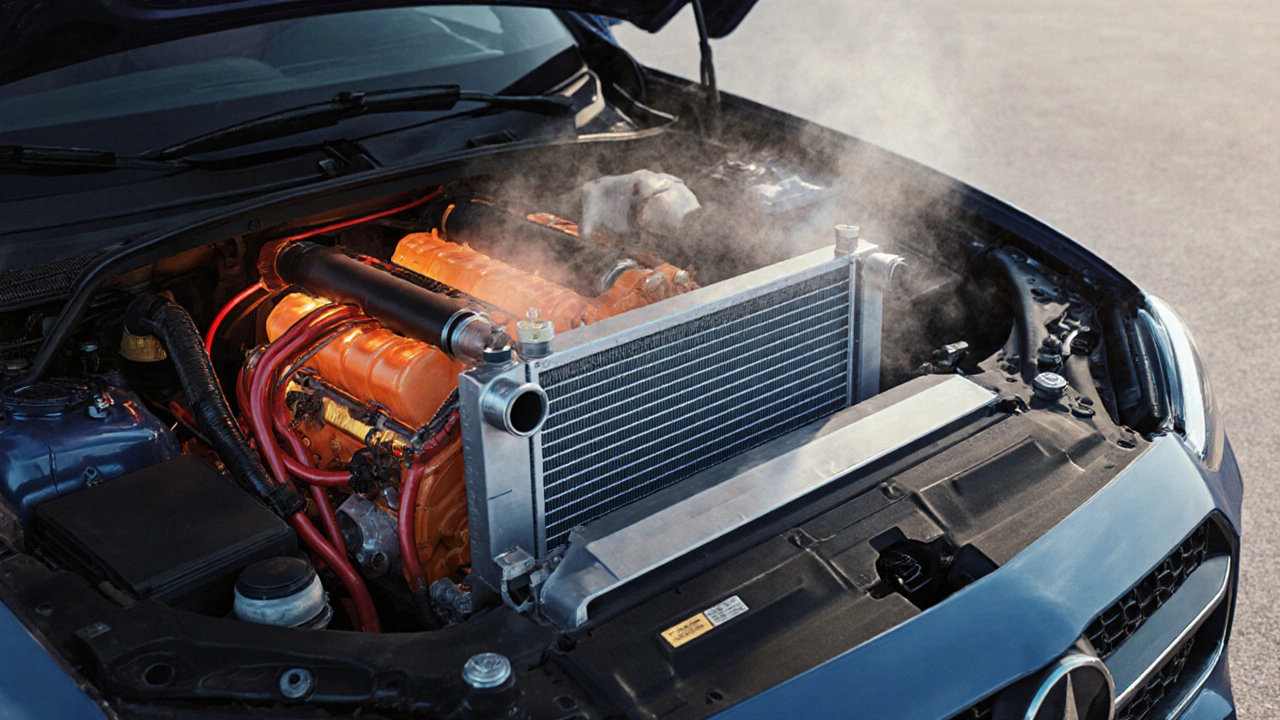
What Determines a Car Radiator's Life Expectancy?
Learn how long a car radiator typically lasts, what factors affect its durability, signs of failure, maintenance tips, and cost of replacement.
View moreWhen your radiator, the main component that cools your engine by circulating coolant through a network of tubes and fins. Also known as a heat exchanger, it’s the unsung hero keeping your engine from turning into a melted mess. Fails, your car doesn’t just stall—it can die permanently. A single ignored leak or clogged passage can turn a $150 fix into a $2,000 engine rebuild. You don’t need to be a mechanic to protect it. Just know what to look for and when to act.
The cooling system, the full network of hoses, water pump, thermostat, and radiator that works together to regulate engine temperature is simple, but it’s not magic. It runs on coolant, and coolant breaks down. Over time, it turns acidic, eats metal, and leaves gunk inside your radiator. That’s why checking fluid levels every few weeks isn’t optional—it’s survival. If your coolant looks rusty or has bits floating in it, don’t wait for the temperature light to come on. That’s already too late.
And don’t forget the thermostat, the valve that controls when coolant flows through the radiator. A stuck thermostat is one of the most common causes of overheating—and it’s cheap to replace. If your car takes forever to warm up in winter, or overheats right after starting, that’s your thermostat crying for help. Same goes for leaks. A slow drip under your car isn’t just a mess—it’s a countdown to engine failure. Coolant isn’t water. It’s expensive, toxic, and vital. Ignoring it won’t save you money.
Some people think radiator problems only happen in summer. They’re wrong. Winter kills radiators too. Cold weather makes coolant thicker, puts more stress on the system, and turns tiny cracks into big leaks. If you’ve ever had your car die on a freezing morning, the radiator might be the real culprit, not the battery.
What you’ll find below are real, no-fluff guides on what actually goes wrong with radiators, how long replacements take, what signs you can spot yourself, and how to avoid being ripped off at the shop. You’ll learn why some "premium" radiator flushes are scams, how to test your radiator cap without tools, and why mixing coolant types is a bad idea—even if the bottle says it’s "universal." This isn’t theory. These are the exact issues mechanics see every day, and the fixes that actually work.
Learn how long a car radiator typically lasts, what factors affect its durability, signs of failure, maintenance tips, and cost of replacement.
View more