Oil Level Checker
Enter your vehicle type and dipstick reading to check if your oil level is safe. Results show if you're below minimum, in the safe zone, or overfilled.
Getting the oil level right on your dipstick isn’t just a routine check-it’s one of the simplest ways to keep your engine from blowing up. Too little oil, and your engine parts start grinding together. Too much, and you’re asking for serious damage too. So how high should oil actually be on a dipstick? The answer is simple: between the two marks. Not above, not below. Just between them.
What the Dipstick Marks Mean
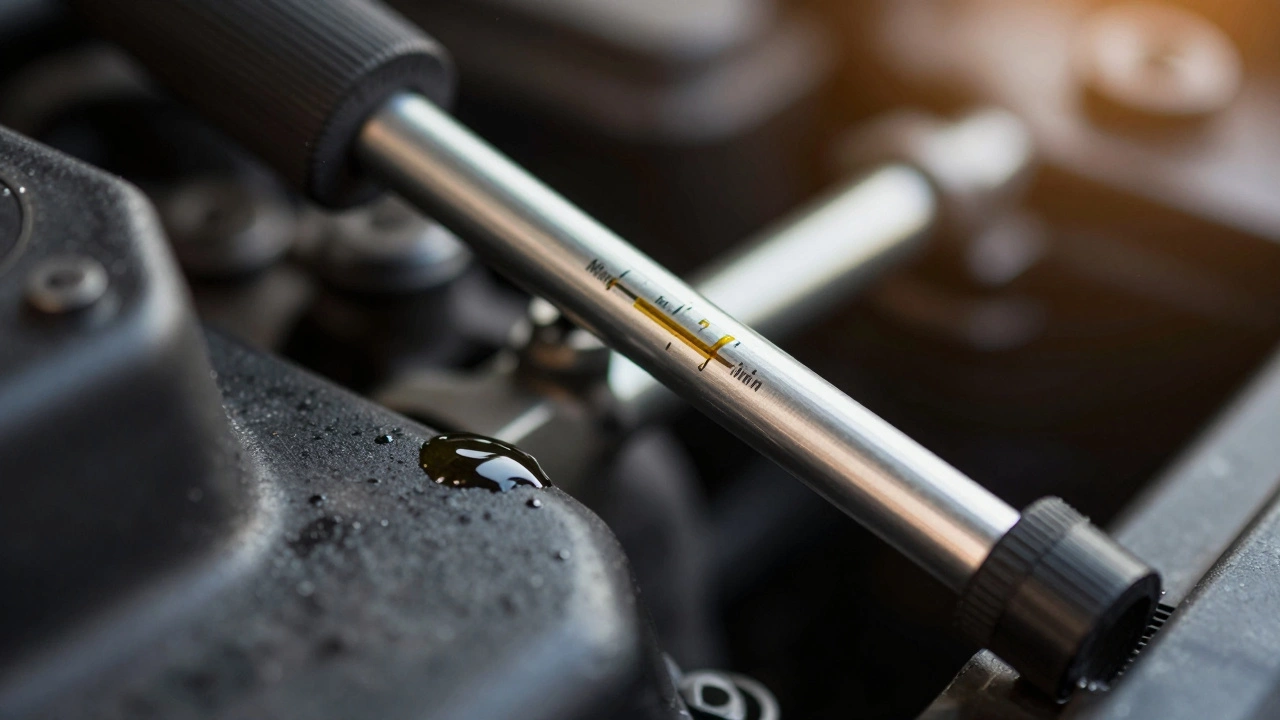
Every dipstick has two marks: a minimum (often labeled "L" or "Add") and a maximum ("H" or "Full"). These aren’t suggestions. They’re hard limits set by the engine manufacturer based on how much oil the crankshaft, oil pump, and other parts need to function safely. The space between them? That’s your safe zone. When you pull out the dipstick and see the oil right between those two lines, you’re golden.
Some dipsticks have a crosshatch area instead of two lines. That’s the same idea-the oil should cover part of that area. If it’s below the bottom of the crosshatch, you’re low. If it’s above the top, you’re overfilled. No guesswork needed.
Why Being Even a Little Low Is Dangerous
Let’s say your oil is just a quarter inch below the minimum mark. Sounds harmless, right? It’s not. Engines don’t run on "almost enough." When oil drops below the minimum, the oil pump can’t pull enough to lubricate critical parts like the camshaft, valve train, and rod bearings. You might not notice it right away. But over time, those parts start wearing faster. Metal-on-metal contact creeps in. That’s how you go from a $50 oil change to a $5,000 engine rebuild.
Real-world example: A 2020 Toyota Camry with 85,000 miles came in with a noisy engine. The owner thought it was just "a little low"-only about half an inch below the minimum. Turns out, the oil pump was starving the timing chain tensioner. The chain jumped. The valves bent. Total repair cost: $4,200. All because someone didn’t check the dipstick properly.
Why Too Much Oil Is Just as Bad
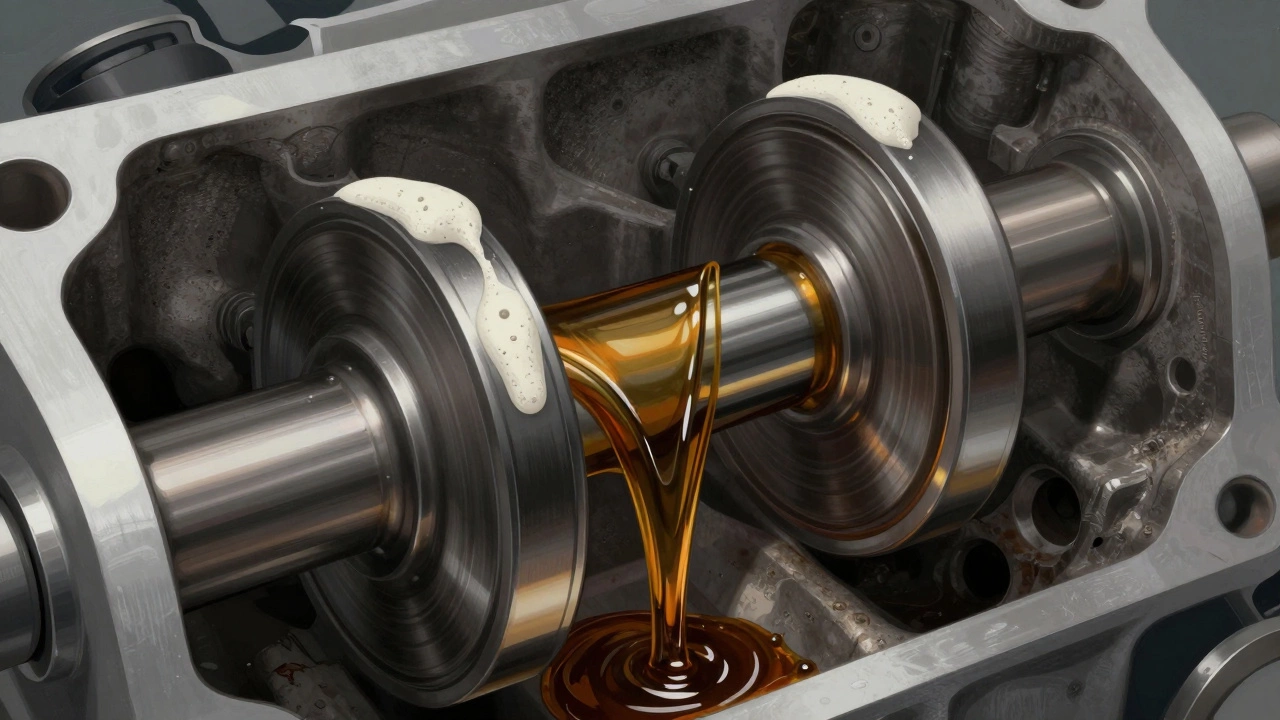
Some people think, "More oil can’t hurt." That’s a myth. When oil rises above the maximum mark, the spinning crankshaft starts whipping it into a froth. Think of it like shaking a soda bottle. Foam doesn’t lubricate. It just flows around, leaving parts dry. That’s called aeration, and it’s a silent killer.
Overfilled oil also puts pressure on seals and gaskets. The valve cover gasket, oil pan gasket, crankshaft seal-they weren’t designed to hold extra pressure. The result? Leaks. You’ll start seeing oil spots under your car, or worse, smoke from the exhaust as oil gets burned in the combustion chamber. A 2023 Honda Civic owner added an extra quart thinking it would "protect" the engine. Within 2,000 miles, the PCV valve clogged, the engine burned 1 quart every 500 miles, and the catalytic converter turned to slag. Repair cost: $3,100.
How to Check Oil Correctly
Checking oil isn’t as simple as pulling the dipstick and glancing. Here’s how to do it right:
- Warm up the engine. Run it for 3-5 minutes, then turn it off. Cold oil doesn’t settle properly.
- Wait 5 minutes. Let the oil drain back into the pan. Don’t check right after turning off the engine.
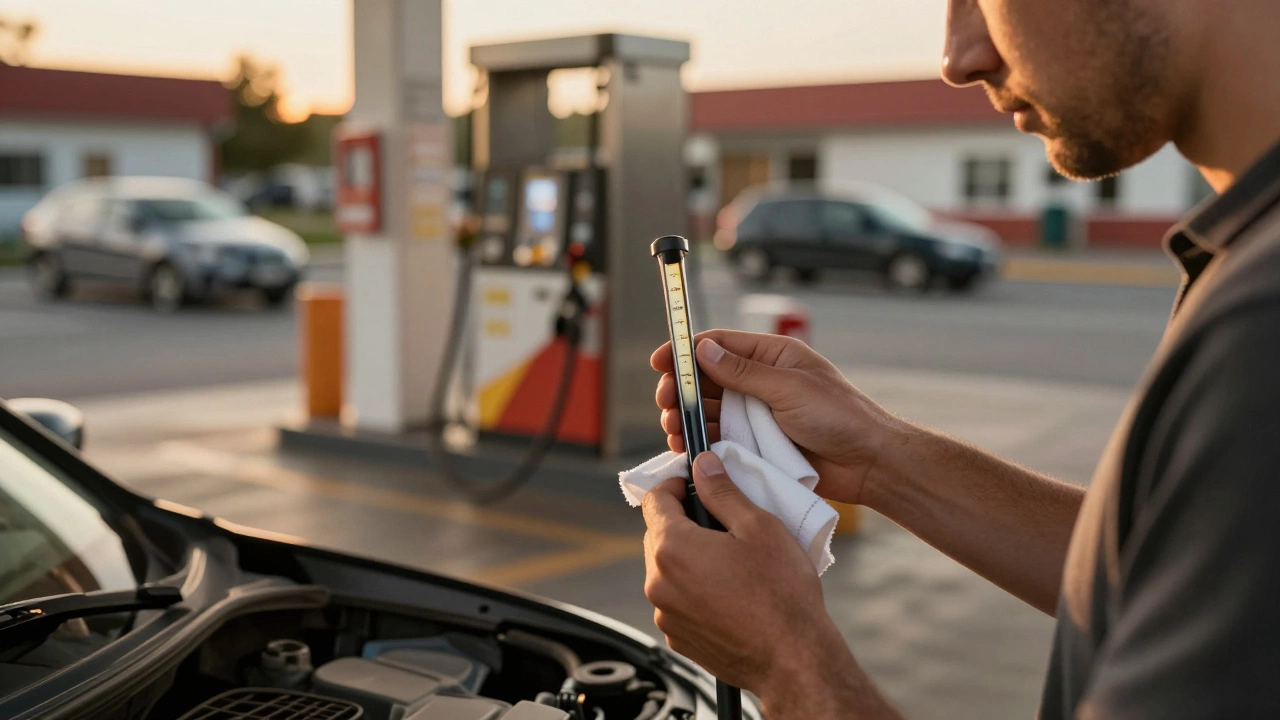
- Pull the dipstick out and wipe it clean with a lint-free rag. Don’t use paper towels-they shed fibers.
- Reinsert it fully, then pull it out again. Look at the oil level against the markings.
- Don’t guess. If it’s below the minimum, add oil in small amounts-half a quart at a time. Recheck after each addition.
Pro tip: Check oil at the same time every week. Make it part of your routine, like checking tire pressure. That way, you catch slow leaks before they become emergencies.
Dipstick Variations Across Vehicles
Not all dipsticks are the same. Older cars often have a simple two-mark system. Newer models, especially European ones, might have a digital oil level sensor. But even those rely on the same physical limits. Some SUVs and trucks have dipsticks with three marks: cold, hot, and a range in between. Always refer to your owner’s manual. If it says "check when engine is warm," don’t ignore it.
Electric vehicles? They don’t have oil dipsticks. But if you’re driving a hybrid, you still need to check the engine oil. Many people forget that.
What If You’re Between Marks? Should You Top Off?
If your oil level is right in the middle of the two marks, leave it alone. No need to add anything. The system is designed to hold a specific volume-usually 4 to 6 quarts depending on the engine. Adding more doesn’t help. It just creates risk.
If it’s halfway between minimum and maximum, you’re still fine. But if it’s even a little below minimum, add oil. Use the same type and viscosity as what’s already in the engine. Mixing oils isn’t ideal, but it’s better than running dry. Always check the label on the oil bottle for the correct API rating and weight (like 5W-30).
Signs You’ve Got Too Much or Too Little Oil
Here’s what to watch for:
- Too low: Engine noise (ticking or knocking), overheating warning light, oil pressure light on, burning smell.
- Too high: Blue smoke from exhaust, oil leaks around seals, rough idle, decreased fuel economy, check engine light with P0171 or P0174 codes (fuel trim issues caused by oil in the combustion chamber).
If you see any of these, don’t wait. Check the dipstick immediately. If you’re unsure, don’t guess. Pull over, turn off the engine, and wait 10 minutes before checking.
How Often Should You Check?
Check your oil every time you fill up with gas. That’s about once a week for most drivers. If you drive less than 500 miles a week, check it every 5 days. Modern engines can burn oil slowly, especially if they’re over 75,000 miles. A 2018 Ford F-150 with 110,000 miles burned 0.3 quarts per 1,000 miles. That’s not normal-but it’s common. Checking weekly caught it before the engine was damaged.
Also, check after long trips, if you’ve been towing, or if you notice any unusual engine behavior. Oil doesn’t just disappear. If it’s dropping fast, something’s wrong-a leak, a worn piston ring, a bad PCV valve. Don’t ignore it.
Final Rule: Keep It Between the Lines
There’s no magic number. No perfect measurement. Just two lines. Oil between them = engine happy. Oil below = risk. Oil above = risk. It’s that simple. Most engine failures from oil issues happen because someone ignored this basic check. You don’t need a mechanic to tell you this. You just need five seconds every week.
Next time you’re at the pump, grab a rag, pull the dipstick, and look. You’re not just checking oil. You’re protecting a $20,000 investment. And it only takes a moment.
What if my dipstick has no markings?
If your dipstick has no markings, consult your owner’s manual. Some older vehicles use a length-based system-for example, "oil should reach 1 inch from the tip." If you can’t find the manual, take the dipstick to a parts store. They can compare it to the correct one for your vehicle. Never guess the level without a reference.
Can I use any type of oil to top off?
You should use the same viscosity and API rating as the oil already in the engine. For example, if your car calls for 5W-30 synthetic, use that. Mixing different viscosities (like 5W-30 with 10W-40) isn’t ideal but won’t cause immediate damage. Mixing synthetic with conventional is okay in emergencies. But don’t make it a habit. Always replace the entire oil with the correct type during your next change.
Why does oil level change after the engine cools?
When the engine is hot, oil expands and some clings to engine parts. When it cools, oil drains back into the pan, which can make the level appear lower. That’s why you always check after the engine has been off for 5 minutes-so the oil has time to settle. Never check while the engine is still warm.
Is it normal for oil to drop between changes?
A small amount of oil consumption is normal-up to 1 quart per 3,000 miles in older engines. But if you’re losing more than that, or if the level drops noticeably between checks, you have a problem. Common causes: leaking gasket, worn piston rings, or a faulty PCV valve. Don’t assume it’s normal. Investigate.
Should I check oil with the car on level ground?
Yes. Always check oil on a flat surface. If your car is parked on a hill, the oil shifts to one side of the pan. That gives you a false reading. Even a 5-degree incline can throw off the level by a quarter inch. Pull into a level parking spot before checking.