Clutch Labor Cost Calculator
Clutch Labor Cost Estimator
Estimate labor costs for your clutch replacement based on vehicle type and additional services. This tool is designed for the national averages discussed in our article.
Select vehicle type and additional services to see your estimated labor cost.
Replacing a clutch kit isn’t like changing your oil. It’s one of those jobs that sounds simple until you’re under the car for eight hours with aching shoulders and a toolbox full of broken bolts. And when you see the final bill, you might wonder: how much is labor for a clutch kit? The answer isn’t a single number-it depends on your car, where you live, and who’s doing the work.
Why Clutch Labor Costs So Much
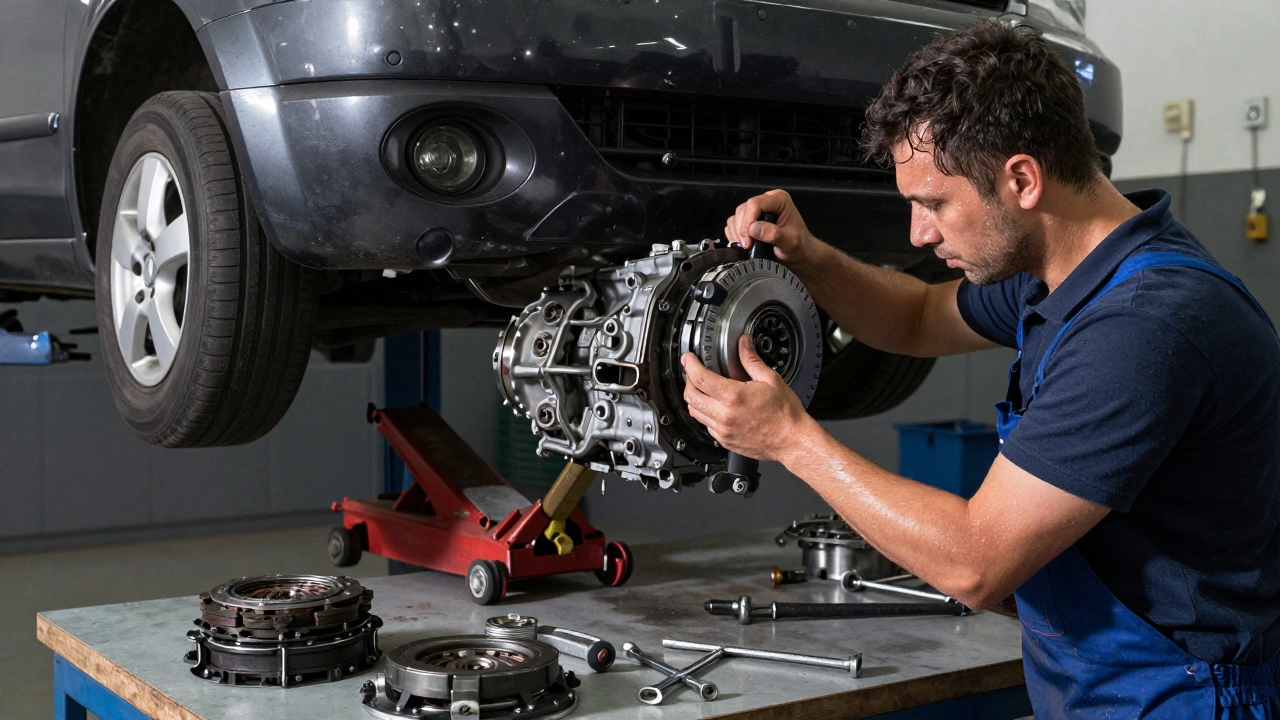
You might think, "It’s just a clutch. Why does it take so long?" But a clutch isn’t plugged in like a lightbulb. It’s buried deep inside the transmission, sandwiched between the engine and the drivetrain. To get to it, the mechanic has to pull the transmission-or sometimes the entire engine-out of the car. That’s not a quick swap. It’s a full disassembly.
On average, labor for a clutch replacement takes between 5 and 8 hours. Some vehicles, like older Volkswagens or rear-wheel-drive muscle cars, can take as little as 4 hours. But modern front-wheel-drive cars with transverse engines? Those can run 8 to 12 hours. Why? Because everything’s crammed into a tight space. The exhaust, suspension, wiring, and coolant lines all have to be moved out of the way before you even touch the clutch.
And it’s not just time. It’s skill. If the flywheel isn’t resurfaced properly, or if the pilot bearing isn’t replaced, the new clutch will fail in months. A good mechanic doesn’t just swap parts-they inspect, clean, torque, and test. That’s why you pay for expertise, not just hours.
Typical Labor Costs by Vehicle Type
Here’s what you’re likely to pay for labor in early 2026, based on national averages from repair databases and independent shops:
- Compact cars (Honda Civic, Toyota Corolla): $450-$650
- Midsize sedans (Honda Accord, Toyota Camry): $550-$750
- SUVs and trucks (Ford F-150, Toyota Tacoma): $700-$1,000
- Performance cars (Subaru WRX, Mazda MX-5): $800-$1,200
- European cars (Volkswagen Golf, BMW 3 Series): $900-$1,400
European and performance cars cost more because they use proprietary tools, specialized alignment procedures, and sometimes require transmission reprogramming after reassembly. A BMW clutch job might need a diagnostic scan to reset the clutch learning mode-something a generic shop won’t have the software for.
What’s Included in the Labor Price
When a shop quotes you $800 for labor, what are you actually paying for? Here’s the breakdown:
- Draining transmission fluid and disconnecting shift cables
- Removing the driveshafts, exhaust components, and starter motor
- Detaching the transmission from the engine (this is the heaviest, most delicate part)
- Removing the old clutch, pressure plate, and pilot bearing
- Inspecting and resurfacing the flywheel (if needed)
- Installing the new clutch kit, aligning the input shaft, and torquing bolts to spec
- Reinstalling the transmission and reconnecting all components
- Refilling fluid and testing clutch engagement, pedal feel, and gear shifts
Some shops include a new throw-out bearing and pilot bearing in the labor price. Others charge extra. Always ask: "Is the pilot bearing included?" If it’s not, you’re looking at an extra $50-$100. And if the flywheel is worn, you’ll need it resurfaced or replaced-that’s another $150-$300.
Dealership vs. Independent Shop vs. DIY
You’ve got three real options: dealership, independent shop, or doing it yourself.
Dealerships charge the most-often $1,200 to $1,800 in labor. They use factory-trained techs and OEM parts, which is great for warranty coverage, but you’re paying for brand premium. If your car is still under warranty, this is your only option.
Independent shops are where most people go. You’ll find solid work for $600-$1,100 in labor, depending on location. Look for shops that specialize in transmissions or have ASE-certified mechanics. Ask if they use OEM or high-quality aftermarket parts like LUK, Sachs, or Exedy. Avoid places that use cheap, no-name clutch kits.
DIY saves you all the labor cost-but only if you’re prepared. A clutch kit costs $300-$800 depending on your car. Add tools: a transmission jack ($150), torque wrench ($80), clutch alignment tool ($30), and a few specialty sockets. You’ll need a garage, a lift or jack stands, and at least two days. One mistake-like cross-threading a bolt or not torquing the pressure plate correctly-and you could destroy a $2,000 transmission. Most people who try it end up paying twice as much to fix their own mess.
Hidden Costs You Might Not See Coming
Clutch jobs have a habit of revealing other problems. Here’s what often shows up after the transmission comes out:
- Worn flywheel: If it’s cracked, warped, or has deep grooves, it must be replaced. Resurfacing only works if the flywheel is thick enough. Most modern flywheels are dual-mass and can’t be resurfaced at all.
- Leaking rear main seal: That’s the seal between the engine and transmission. If it’s leaking, you’ll need to replace it while the transmission is out. Adds $150-$250 in labor.
- Worn input shaft bearing: If you hear a whine in neutral or grinding when shifting, this might be the culprit. Replacement adds $200-$400.
- Shifter cable or linkage damage: Often brittle with age. Replacing it while everything’s apart is smart.
Good shops will give you a call before adding these repairs. Bad ones will just charge you for them. Always ask: "What else might need attention once we open it up?"
How to Avoid Getting Ripped Off
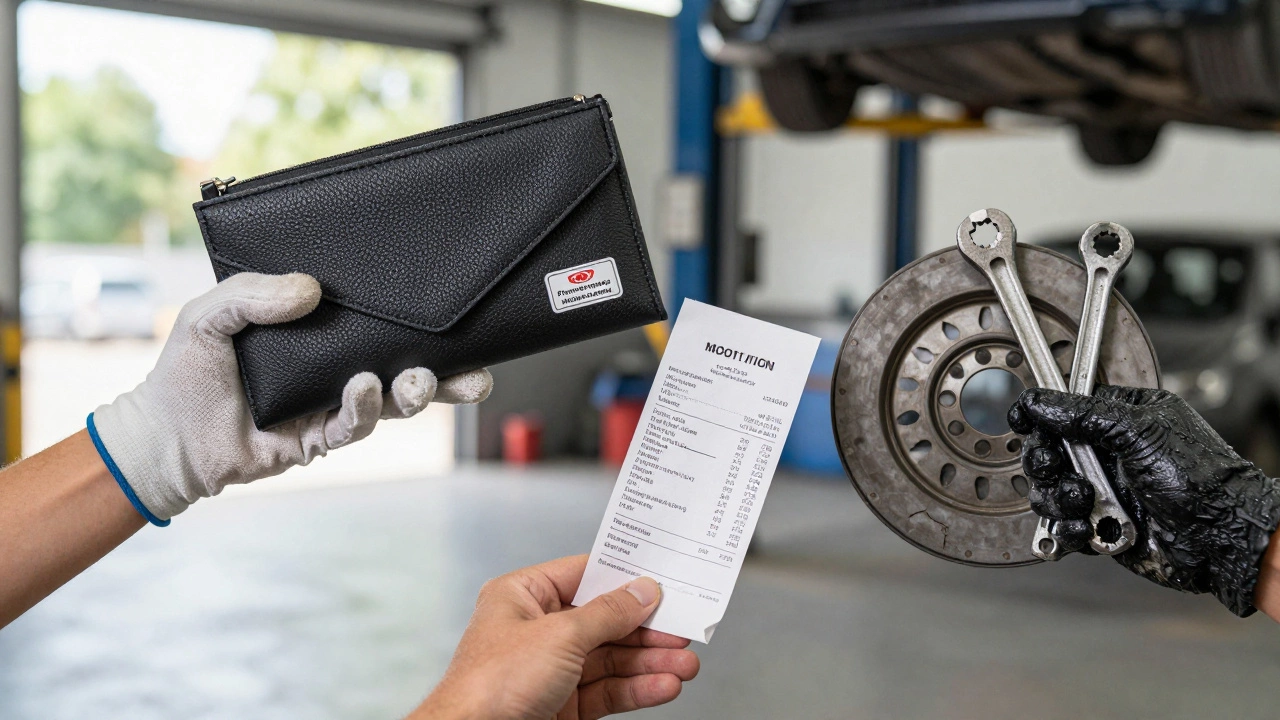
Here’s how to walk into a shop and walk out with a fair deal:
- Get at least three written quotes. Don’t just ask for a price-ask for a line item breakdown of labor and parts.
- Ask if the quote includes the pilot bearing, throw-out bearing, and flywheel resurfacing. If not, add those in.
- Check reviews on Google and Yelp. Look for comments about transparency, cleanliness, and communication.
- Ask if they offer a warranty on labor. Reputable shops give 12 to 24 months.
- Don’t be swayed by the lowest price. A $400 clutch job usually means a $150 clutch kit and corners cut.
Clutch replacement is one of the most expensive repairs you’ll face. But it’s also one of the most important. A failing clutch doesn’t just make driving hard-it can leave you stranded on the highway. Paying a little more now for quality work saves you from a much bigger bill later.
When to Replace Your Clutch
You don’t wait until it’s completely dead. Signs your clutch is wearing out:
- Slipping when accelerating, especially uphill or under load
- Clutch pedal feels spongy or goes all the way to the floor
- Grinding noises when shifting
- Difficulty getting into gear, especially first or reverse
- Smell of burning friction material (like overheated brakes)
Most clutches last 60,000 to 100,000 miles. But if you drive in stop-and-go traffic, tow trailers, or ride the clutch, you might need a replacement at 40,000 miles. Keep a log of your driving habits-it helps mechanics diagnose faster.
Is it worth replacing the clutch if my car is old?
If your car is in good condition otherwise-no major rust, solid engine, good transmission-then yes. A clutch replacement can add another 50,000 to 100,000 miles of life. If the car is worth more than $3,000, spending $1,500 on a clutch is a smart investment. If the car has other serious issues, like a blown head gasket or frame damage, it’s better to walk away.
Can I drive with a bad clutch?
Technically, yes-but you shouldn’t. Driving with a slipping clutch puts extra stress on the transmission, flywheel, and shifter mechanism. You risk breaking the input shaft or damaging the gear synchronizers, which can cost $2,000 to fix. If you notice slipping, get it checked within a week.
Do I need to replace the flywheel every time?
Not always, but you should inspect it. If it’s smooth, not warped, and has no deep grooves or cracks, resurfacing is fine. But if it’s a dual-mass flywheel (common in diesel and European cars), it’s usually not worth resurfacing. These are designed to be replaced as a unit. Reusing a worn dual-mass flywheel can cause vibrations and premature clutch failure.
How long does a new clutch last?
A quality clutch kit installed correctly lasts 60,000 to 100,000 miles. Aggressive driving, frequent towing, or riding the clutch pedal can cut that in half. Using a high-performance clutch in a daily driver? It might wear faster and feel harsher. Stick with OEM-grade kits unless you’re racing.
Can I replace just the clutch disc and not the pressure plate?
No. Clutch kits include the disc, pressure plate, and release bearing as a matched set. The pressure plate wears in sync with the disc. Replacing only one part causes uneven pressure, slippage, and early failure. Always replace the entire kit.
Next Steps: What to Do Now
If you think your clutch is failing, don’t wait. Start by checking your owner’s manual for the recommended replacement interval. Then, call three local shops and ask for a written estimate that includes labor, parts, and warranty. Bring your car in for a quick inspection-many shops offer free clutch checks.
Once you have quotes, compare them line by line. Look for the same parts, same labor steps, and same warranty. The cheapest isn’t always the best-but the most transparent is always the safest. And if you’re unsure? Trust a shop that explains things clearly, not one that just gives you a number and walks away.