Brake Pad Thickness Calculator
Check Your Brake Safety
Determine if your brake pads need replacement based on thickness and driving conditions. The article explains that pads below 3mm are dangerous and significantly increase stopping distance.
You hear a high-pitched squeal when you slow down. Or maybe your car pulls to one side when you hit the brakes. These aren’t just annoyances-they’re warnings. Brake pads wear out over time, and if you ignore the signs, you could end up with damaged rotors, longer stopping distances, or worse-losing control when you need to stop fast.
Listen for the warning sound
Most brake pads have a small metal tab built into them. When the friction material wears down to about 2mm, that tab scrapes against the rotor. It’s not a squeak from dirt. It’s a sharp, metallic squeal that’s loud enough to hear over music or conversation. This isn’t designed to annoy you-it’s a legal safety feature. If you hear this sound consistently, especially when braking lightly, don’t wait. Get them checked within the next 500 kilometers.
Some drivers ignore it, thinking it’s just "the car being noisy." But if you let it go, you’ll eventually hear a grinding noise. That’s metal-on-metal. Your rotors are now being scored. Replacing rotors costs three times more than replacing pads alone.
Check the thickness
You don’t need a mechanic to see how much pad material is left. Most cars let you see the brake pads through the spokes of the wheel. Look through the gap between the wheel and the caliper. You should see a flat, dark gray or black pad pressing against a shiny metal rotor.
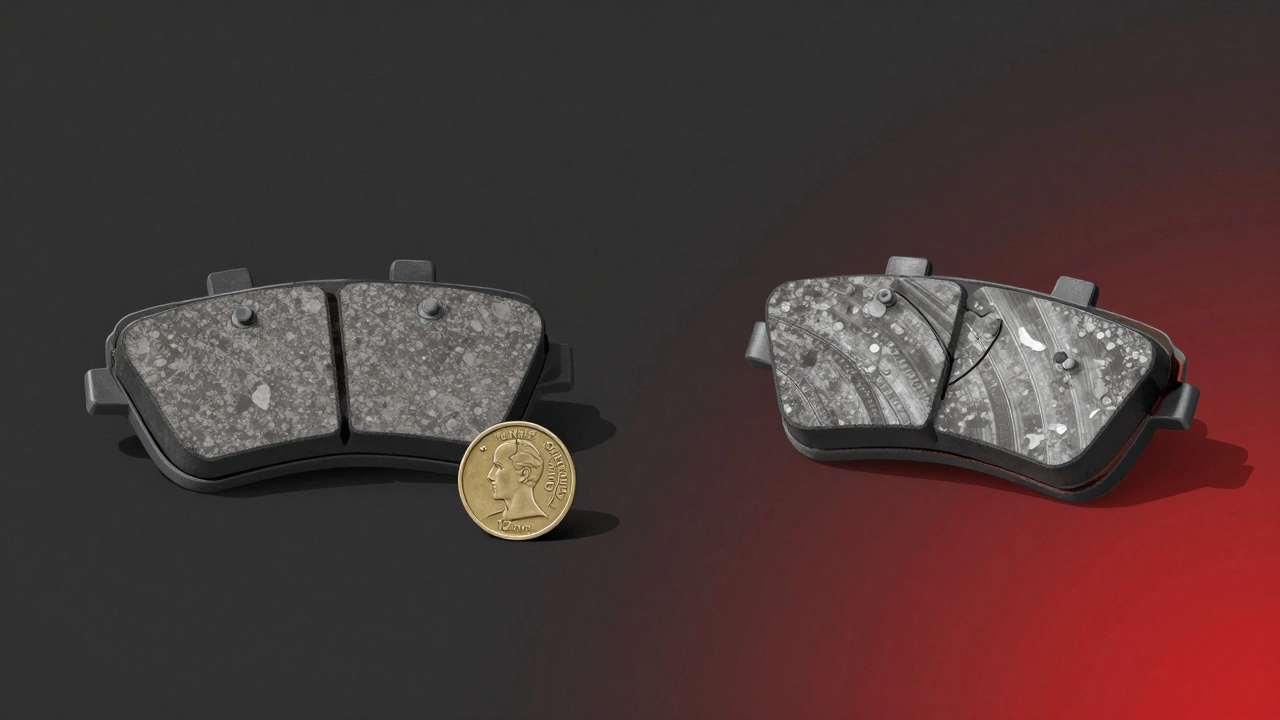
If the pad looks thinner than a quarter (about 5mm), it’s time to think about replacement. If it’s less than 3mm, you’re already in danger zone. A brand-new brake pad starts at around 10-12mm thick. Once it drops below 2mm, the wear indicator activates, and the pad’s stopping power drops sharply. In Australia, where heavy loads and hilly terrain are common, brake pads often wear faster than in flat regions.
Feel the pedal
Brakes should feel firm and responsive. If you notice the pedal sinking closer to the floor before the car slows down, something’s wrong. Worn brake pads reduce hydraulic pressure efficiency. You might also feel vibration or pulsing through the brake pedal. That’s usually a sign of warped rotors-but warped rotors often happen because worn pads were left too long.
Another red flag: you need to press harder to stop. If you used to stop smoothly at 30 km/h with light pressure, but now you’re pushing halfway down, that’s not normal. It’s not just "getting older." It’s a safety issue.
Watch for pulling or drifting
If your car tugs to the left or right when you brake, it’s not alignment. It’s uneven brake pad wear. One side is gripping harder than the other. That can happen if a caliper is sticking, or if one pad is worn down more than the other. In either case, it’s a sign the system is out of balance.
Driving with uneven braking isn’t just uncomfortable-it’s dangerous. On wet roads or during emergency stops, that imbalance can cause skidding or loss of control. If your car pulls to one side, get it checked immediately. Don’t wait for the next service.
Pay attention to dashboard lights
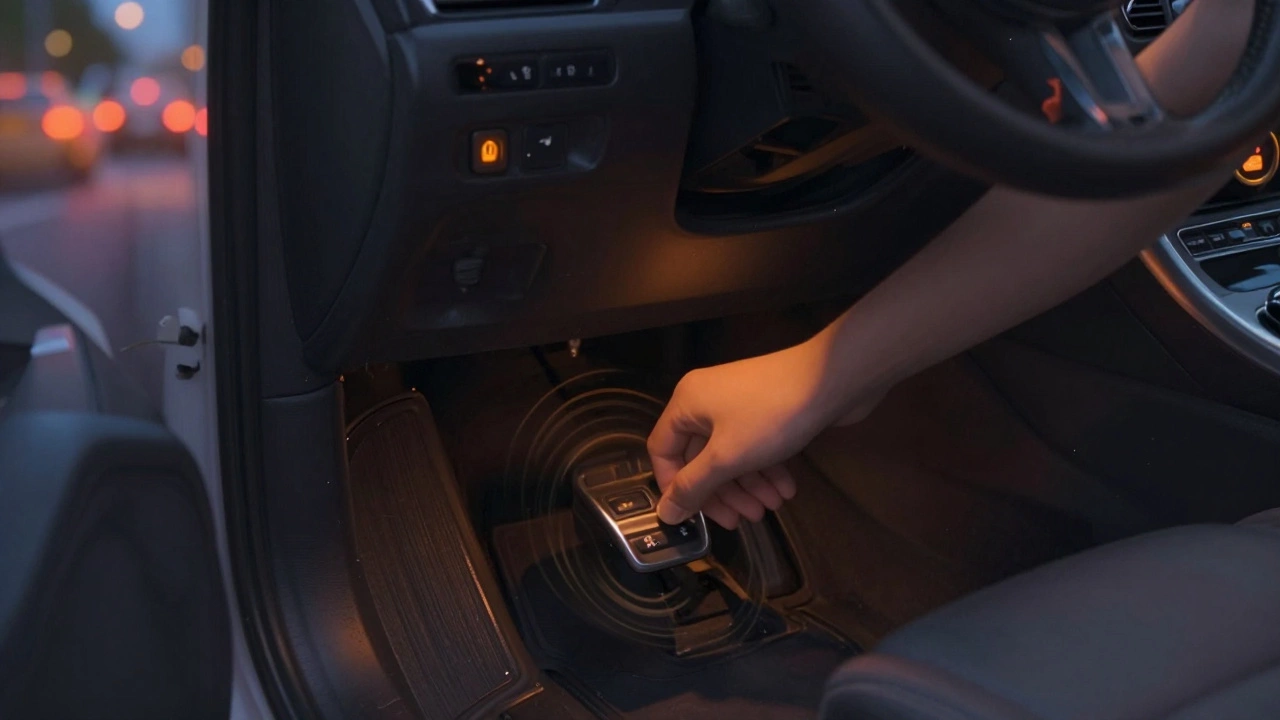
Some modern cars have brake pad wear sensors. If the brake warning light comes on-usually a circle with an exclamation mark inside or the word "BRAKE"-it’s not about low fluid. It’s telling you the pads are worn past safe limits. This sensor triggers when the pad thickness drops below 1.5mm. If this light shows up, don’t drive more than 100 kilometers. Replace the pads before your next trip.
Older cars don’t have sensors. That’s why you need to check manually. Don’t rely on the light if your car is over 10 years old.
Consider your driving habits
Brake pad life isn’t one-size-fits-all. If you drive mostly on highways, your pads might last 60,000 to 80,000 kilometers. But if you’re in stop-and-go traffic-like Adelaide’s rush hour or the Hills Face Road near Mount Lofty-you could wear them out in 30,000 to 40,000 kilometers.
Heavy loads also speed up wear. Towing a trailer, carrying roof racks full of gear, or regularly hauling tools and equipment? Your pads are working harder. Same goes for mountain driving. Frequent braking on steep descents heats up the system and wears the material faster.
Aggressive driving-hard braking from high speeds-burns through pads quicker than smooth, predictive driving. If you’re the type who waits until the last second to brake, you’re shortening the life of your brakes.
Don’t wait for the service interval
Many people think, "I’ll wait until my next service." But services happen every 10,000 to 15,000 kilometers. If your pads are at 3mm now, you might only have 5,000 kilometers left. Waiting could mean a rotor replacement you didn’t plan for.
Check your brake pads every 10,000 kilometers. That’s about every six months if you drive 1,500 km/month. It takes five minutes to look through the wheel. No tools needed. Just a flashlight and your eyes.
Even if you don’t hear noise or feel anything strange, visual inspection is your best defense. Most brake failures happen because drivers assumed everything was fine.
What happens if you delay
Ignoring worn brake pads doesn’t just cost more-it risks lives. As pads wear, braking distance increases. Studies show that at 60 km/h, a car with 1mm-thick pads needs 20% longer to stop than one with 8mm pads. That’s the length of a full parking space.
Worn pads also overheat the rotors. That causes warping, which leads to vibration, noise, and reduced braking power. Once the rotor is damaged, you’re looking at $400-$800 in extra repairs instead of $150-$300 for pads alone.
And if you drive with metal-on-metal contact for too long, you can damage the calipers or even cause a brake fluid leak. That’s when you’re not just replacing parts-you’re risking a total brake failure.
When in doubt, get it checked
If you’re unsure whether your brake pads need replacing, don’t guess. Take your car to a trusted mechanic. A good shop will show you the old pads and the new ones side by side. They’ll measure the thickness with a caliper. They’ll spin the rotors to check for warping. And they’ll explain what they found in plain terms.
Ask for a photo of the pads before replacement. That way, you know exactly what you paid for. Reputable shops won’t push unnecessary work-but they also won’t hide the truth.
Brakes aren’t something you fix when it’s convenient. They’re the reason you get home safe. Don’t wait for the grinding. Don’t wait for the warning light. Check them regularly. Listen. Look. Feel. Your life depends on it.
How often should brake pads be replaced?
There’s no fixed timeline. Brake pads last between 30,000 and 80,000 kilometers, depending on driving style, vehicle weight, and terrain. City drivers with heavy traffic often need replacements every 40,000 kilometers, while highway drivers may go 70,000 or more. Always check thickness visually every 10,000 kilometers.
Can I drive with worn brake pads?
Technically, yes-but it’s dangerous. Once pads wear below 3mm, stopping power drops significantly. Below 2mm, the metal wear indicator is active, and rotor damage is likely. Driving with worn pads increases stopping distance and risks total brake failure. Replace them before they reach this point.
Why do my brakes squeak only in the morning?
Morning squeaks are often caused by moisture or rust on the rotors after overnight dampness. A light brake application usually clears it. If the noise continues after a few stops, or happens during dry conditions, it’s likely worn pads. Moisture-related squeaks are normal; persistent squeals are not.
Do I need to replace rotors when replacing brake pads?
Not always. If the rotors are smooth, even, and thicker than the manufacturer’s minimum thickness (usually marked on the rotor edge), you can reuse them. But if they’re warped, scored, or worn unevenly, they must be replaced or resurfaced. Always have them inspected when replacing pads.
Are expensive brake pads worth it?
It depends. Premium pads last longer and produce less dust, but standard ceramic or semi-metallic pads from reputable brands (like Bendix, Akebono, or TRW) perform well for most drivers. Avoid the cheapest pads-they wear fast and can be noisy. You don’t need racing pads for daily driving, but don’t go for the lowest price either.