Fuel Pump Health & Symptom Diagnostic Tool
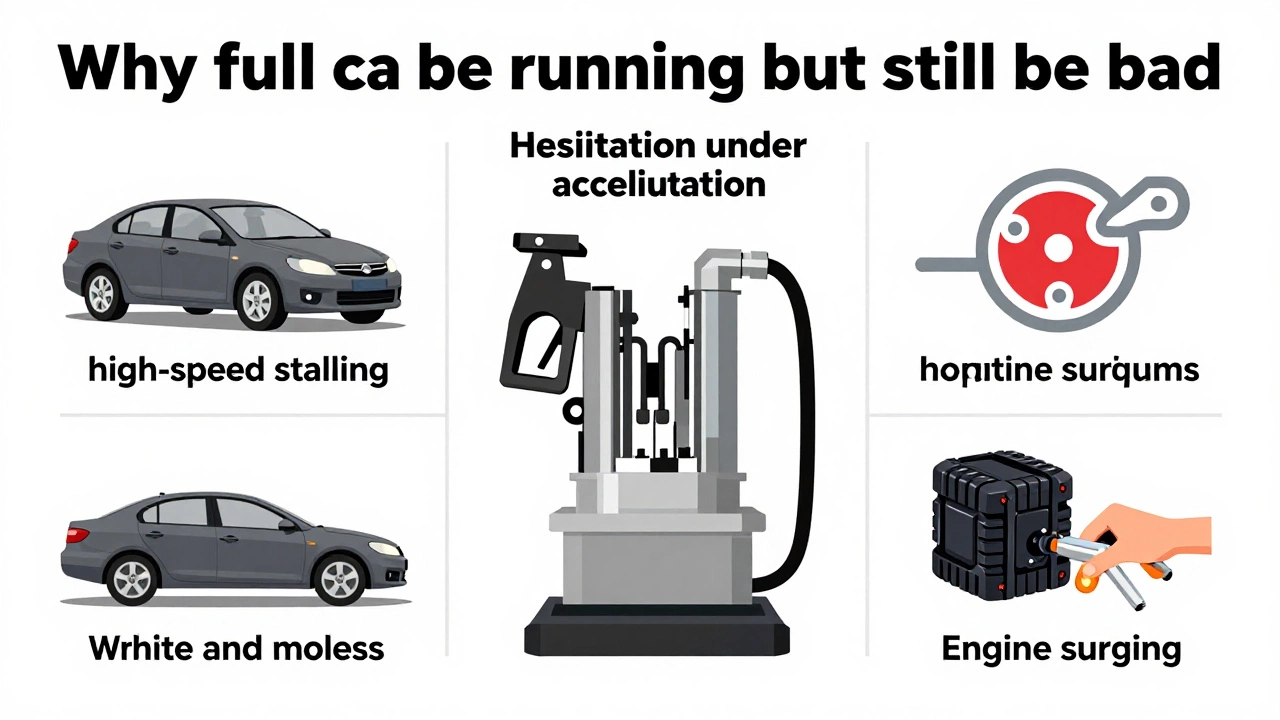
Determine if your fuel pump is failing under load based on common symptoms like high-speed stalling, hesitation, and surging.
Diagnostic Result
Recommended Actions:
Your car starts fine. The engine idles smoothly in the driveway. You even hear that familiar low hum from the back seat when you turn the key to 'on.' It sounds like everything is working perfectly. So why does the car shudder and die every time you hit 60 mph? Or why does it hesitate painfully when you step on the gas to pass a truck?
The answer is frustratingly simple: yes, a fuel pump can run but still be bad. A fuel pump that spins does not necessarily deliver enough fuel pressure or volume to keep your engine running under load. In fact, this is one of the most common misdiagnoses in automotive repair. Mechanics and DIYers alike often assume that if they hear the pump whirring, the fuel system is healthy. They aren’t. A failing pump might spin freely while its internal components wear out, starving your engine of the precise amount of gasoline it needs to perform.
Why a Spinning Pump Isn't Enough
To understand why a running pump can fail, you have to look at what the pump actually does. It doesn't just move liquid; it moves liquid against resistance with specific force. Modern engines rely on Electronic Fuel Injection (EFI), a system that sprays fuel directly into the intake manifold or combustion chamber under high pressure. This system typically requires between 35 and 65 pounds per square inch (PSI) of pressure, depending on the manufacturer.
When a fuel pump begins to degrade, it usually suffers from two types of failure: pressure loss and volume loss. Think of it like a garden hose. If you put your thumb over the end, the water shoots out far (high pressure), but very little water comes out (low volume). If you leave the nozzle wide open, lots of water flows (high volume), but it doesn't go anywhere fast (low pressure). An engine needs both. It needs enough pressure to atomize the fuel for efficient burning, and enough volume to sustain high RPMs and heavy acceleration.
A worn-out pump might generate 40 PSI at idle, which is enough to start the car. But when you floor it, the engine demands more fuel than the tired motor can supply. The pressure drops below the critical threshold, the air-fuel mixture becomes too lean, and the engine stumbles or stalls. The pump is technically "running," but it is functionally dead under load.
The Top Signs Your Fuel Pump Is Failing While Running
If your pump is making noise but not performing, you will notice specific behaviors. These symptoms are distinct from a completely dead pump, which would result in no crank or no start.
- High-Speed Stalling: This is the classic symptom. You are cruising on the highway, maybe climbing a slight incline, and the car suddenly loses power and dies. Once you restart it, it runs fine again until the next demand for power. This happens because the pump cannot maintain pressure during sustained high-load conditions.
- Hesitation Under Acceleration: When you press the accelerator, there is a noticeable lag or "flat spot" before the car responds. The engine feels sluggish, as if it’s choking. This indicates the pump is struggling to increase flow rate quickly enough to match throttle input.
- Engine Surging: Conversely, sometimes the pump delivers inconsistent pressure. You might feel the engine RPMs rise and fall on their own while you’re holding the throttle steady. This suggests the pump’s internal check valve or relief valve is sticking, causing erratic fuel delivery.
- Whining Noise That Changes Pitch: All fuel pumps make some noise. However, a failing pump often produces a loud, high-pitched whine that gets louder as the fuel level drops or as the engine warms up. This noise indicates excessive friction inside the pump motor or cavitation caused by insufficient fuel cooling.
The Hidden Culprit: Fuel Pressure vs. Fuel Volume
Diagnosing a "running but bad" pump requires distinguishing between static pressure and dynamic flow. Many mechanics check the fuel pressure at idle using a gauge connected to the Schrader valve on the fuel rail. If the gauge reads within spec (e.g., 45 PSI for a Ford V6), they declare the pump good. This is a mistake.
You need to perform a Fuel Pressure Drop Test, a diagnostic procedure that measures how much pressure is lost when the engine is turned off. Here is how it works: Start the engine, let it idle, then shut it off. Watch the gauge. In a healthy system, pressure should hold steady for several minutes. If the pressure drops rapidly to zero, your pump’s internal check valve is leaking. This means every time you turn the key, the pump has to work harder to build initial pressure, leading to long cranking times and eventual overheating.
Even more critical is the Fuel Flow Rate Test, a measurement of how many gallons of fuel the pump can deliver per hour. A pump might hold 45 PSI at idle but only deliver 2 gallons per hour (GPH) instead of the required 10 GPH. Without a flow meter, you won’t see this deficiency until the engine fails under stress.
Other Components That Mimic a Bad Pump
Before you replace an expensive fuel pump assembly, rule out these common issues that cause identical symptoms:
| Component | Symptom Similarity | How to Check |
|---|---|---|
| Fuel Filter | High. A clogged filter restricts flow, mimicking a weak pump. | Replace the filter. If performance returns, the pump was fine. |
| Fuel Pressure Regulator | Medium. A stuck regulator can cause rich or lean conditions. | Check for vacuum leaks and inspect the return line for fuel. |
| Mass Air Flow Sensor | Medium. Dirty MAF sends wrong data to ECU, causing hesitation. | Clean with MAF cleaner or scan for trouble codes. |
| Fuel Pump Relay | Low. Usually causes intermittent cutouts, not gradual weakness. | Swap relay with another identical one (e.g., AC relay). |
The Fuel Filter, a mesh screen that traps debris before it reaches the injectors. is the most frequent imposter. In vehicles with inline filters (common in older trucks and diesel engines), a clogged filter creates backpressure that makes the pump sound strained and reduces flow. In modern cars with in-tank screens, dirt buildup on the pickup sock can have the same effect. Always replace the filter before condemning the pump.
Why Heat Kills Fuel Pumps
Fuel pumps are submerged in the tank for a reason: gasoline cools them. As the pump operates, the electric motor generates heat. Liquid fuel absorbs this heat and carries it away. When your tank is low, the pump sits higher relative to the fuel level, exposing more of the motor to air. Air is a poor conductor of heat compared to liquid. Consequently, running on empty repeatedly accelerates wear on the pump’s carbon brushes and bearings.
This thermal degradation explains why a pump might work fine in cool morning traffic but fail during a hot afternoon drive. The combination of ambient heat, engine heat radiating through the floorpan, and lack of coolant fuel causes the pump’s resistance to increase. Higher resistance draws less current, slowing the motor speed and reducing pressure. The pump is running, but it’s thermally throttled.
Diagnosis Steps for the DIY Mechanic
If you suspect a weak pump, follow this logical sequence to confirm without guessing:
- Listen Closely: Turn the key to 'on' (do not start). Listen for the pump. Note if the whine is unusually loud or lasts longer than 2 seconds. A healthy pump primes quickly and quietly.
- Check the Fuse and Relay: Ensure electrical connections are clean. Corroded terminals can cause voltage drop, making the pump run slower than designed. Measure voltage at the pump connector while running; it should be close to battery voltage (12-14V).
- Install a Fuel Pressure Gauge: Connect to the service port on the fuel rail. Record idle pressure. Then, rev the engine to 3,000 RPM and observe if pressure holds or spikes appropriately.
- Perform the Pressure Hold Test: Shut off the engine. Mark the time. Watch the gauge. If pressure drops more than 10 PSI in five minutes, the system is leaking (likely the pump check valve or an injector).
- Inspect the Fuel Screen:** If accessible, remove the pump module and inspect the inlet screen for sludge or debris. Clean or replace it.
Prevention and Longevity Tips
Extending the life of your fuel pump is largely about habit. Keep your fuel tank above the quarter mark. This ensures the pump remains submerged and cooled. Use high-quality fuel from reputable stations to minimize sediment and water contamination. Replace your fuel filter according to the manufacturer’s schedule, typically every 30,000 to 60,000 miles for inline systems.
Remember, a fuel pump is a wear item. Most last between 80,000 and 100,000 miles. If your car is approaching that mileage and exhibiting hesitation or high-speed stalling, don’t wait for it to strand you on the side of the road. Address the fuel delivery system proactively. A running pump isn’t always a reliable one, but catching the decline early can save you from costly towing fees and emergency repairs.
Can a fuel pump fail intermittently?
Yes. Intermittent failures are often caused by worn internal wiring, loose connectors, or a failing relay. The pump may work fine for days, then cut out completely for a few hours before returning. This is dangerous because it provides no warning before a total stall.
How much does it cost to replace a fuel pump?
Parts typically range from $100 to $400 depending on the vehicle. Labor adds another $150 to $500, primarily due to the difficulty of accessing the in-tank pump module. Total costs usually fall between $250 and $900.
Will a bad fuel pump trigger a check engine light?
Often, yes. A weak pump causes a lean fuel condition (too much air, not enough fuel), which triggers codes like P0171 or P0174. However, mild cases may not trigger a light until the damage to oxygen sensors or catalytic converters is significant.
Can I drive with a weak fuel pump?
It is not recommended. Driving with a weak pump risks sudden stalling, especially at intersections or highways, creating safety hazards. Additionally, running lean can overheat the engine and damage expensive components like the catalytic converter.
Does ethanol-free gas help fuel pumps last longer?
Ethanol can attract moisture and degrade certain rubber seals over time. While premium fuel doesn't drastically extend pump life, avoiding contaminated fuel with high water content helps prevent corrosion inside the pump mechanism.