Shock Absorber Health Diagnostic Tool
Answer the following questions about your vehicle's behavior and condition. If you check more than two boxes, it is highly likely that your shock absorbers are worn and need replacement.
You’re driving down a familiar stretch of road, maybe one you’ve taken a thousand times. But today, something feels off. The steering wheel shimmies when you hit a pothole, or the back end of your car seems to float just a second longer than it should after a bump. It’s subtle, but it’s there. Most drivers ignore these early warnings because they don’t hurt immediately. But here is the uncomfortable truth: worn shock absorbers are not just about comfort. They are critical safety components that keep your tires glued to the asphalt. If they fail, your braking distance increases, and your ability to control the vehicle in an emergency drops significantly.
So, how do you know if your shocks are actually damaged versus just being old? It isn’t always obvious until you look for specific symptoms. This guide breaks down the physical signs, audible cues, and simple tests you can perform in your driveway to diagnose suspension health before a mechanic does.
The Bounce Test: A Quick Diagnostic Check
The easiest way to check your shock absorbers is the classic "bounce test." You don’t need any tools, just your hands and a bit of space. Park your car on a flat surface. Go to each corner of the vehicle and push down hard on the hood, trunk, or fender to compress the suspension. Then, let go abruptly.
Here is what you are looking for:
- Healthy Suspension: The car should rebound once and settle immediately. It might wobble slightly, but it stops within one or two oscillations.
- Worn Shocks: The car continues to bounce up and down three or more times like a pogo stick. This indicates the damping force is gone.
While this test is popular, it has limitations. Modern cars with stiffer springs might pass this test even with degraded shocks, especially at low speeds. So, treat a failed bounce test as a definite "yes," but a passed test doesn’t guarantee perfect health. You still need to look for other signs.
Physical Symptoms While Driving
Your car talks to you through its handling. When suspension components wear out, the behavior changes in distinct ways that differ from tire issues or alignment problems.
Nose Dive During Braking
When you slam on the brakes, does the front of your car dip sharply toward the ground? Healthy shocks resist this forward momentum. Worn ones allow the weight to transfer too quickly, causing aggressive nose dive. This isn’t just annoying; it shifts weight away from the rear tires, reducing their grip and potentially making the car unstable during sudden stops.
Rear Squat Under Acceleration
Conversely, when you accelerate hard, watch the rear of the car. If it squats down noticeably while the front lifts, your rear shocks are likely weak. This affects traction, particularly in rear-wheel-drive vehicles where power delivery relies on rear tire contact patch stability.
Body Roll in Corners
Take a roundabout or a curved highway exit at a normal speed. Does the car lean excessively to one side? Excessive body roll means the shocks aren’t controlling the spring movement. This makes the driver feel less confident and can lead to overcorrection, which is dangerous in wet conditions.
Vibration Through the Steering Wheel
If your steering wheel vibrates at higher speeds (above 50 mph), it might be tires. But if the vibration persists after balancing the wheels, it could be worn shocks failing to dampen small road imperfections. These vibrations transmit directly through the steering column, causing driver fatigue on long trips.
Visible Signs of Damage
Sometimes, the problem is visible without even driving. Pop the hood or crouch by the wheel well. Look closely at the shock absorber body. Note: Always ensure the car is cool and securely parked before inspecting under the vehicle.
Oil Leaks
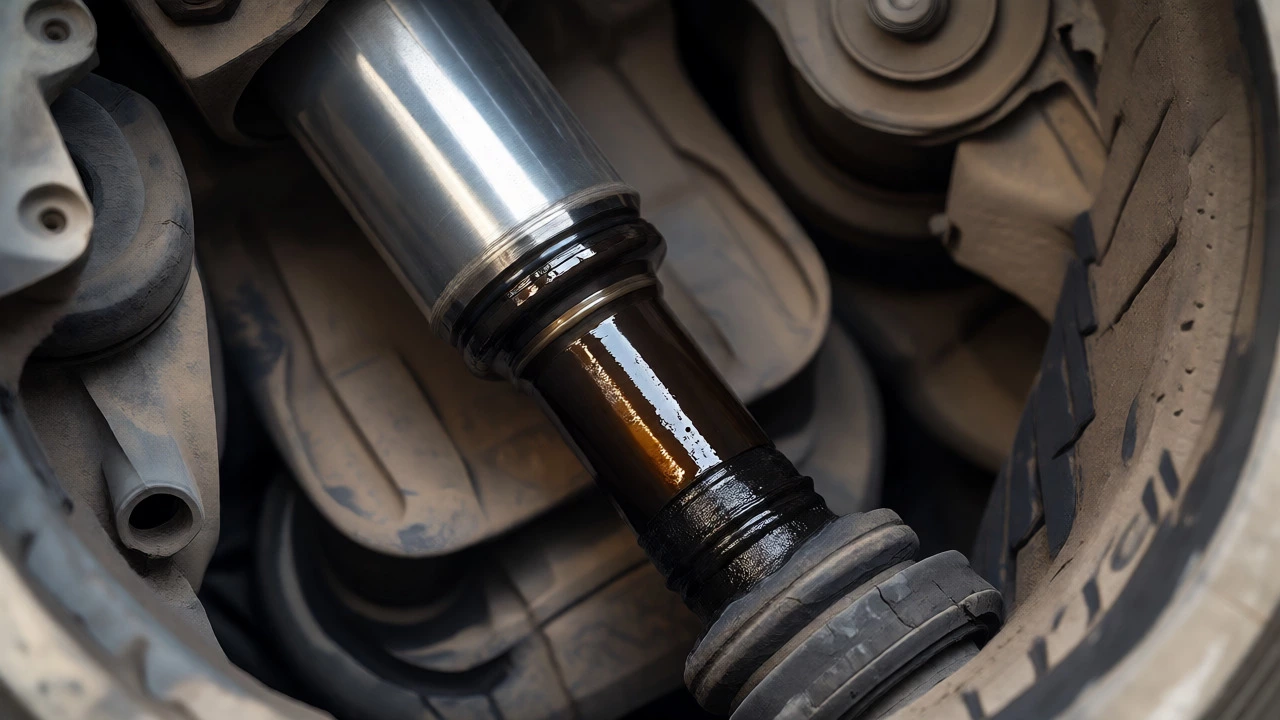
Most modern shocks are hydraulic. They contain oil and gas. If the seal fails, oil leaks out. Look for dark, oily residue coating the lower part of the shock shaft. If the rod looks wet or dirty compared to the clean upper section, the seal is broken. Once the oil escapes, the shock loses its damping ability almost entirely. This is a definitive failure point.
Dented or Bent Rods
Check the piston rod-the shiny metal shaft extending from the shock body. If it is bent, dented, or covered in rust pits, the shock cannot move smoothly. A bent rod will bind inside the cylinder, causing uneven resistance and noise. This often happens after hitting a deep pothole or curb.
Worn Mounts and Bushings
The shock itself might be fine, but the rubber mounts connecting it to the chassis could be cracked or torn. These suspension bushings isolate vibration. When they degrade, you hear clunking noises, and the shock moves independently of the car frame, reducing effectiveness.
Audible Clues: What Do Bad Shocks Sound Like?
Noise is a major indicator. Since shocks manage movement between parts, failures create sounds as metal hits metal or rubber cracks.
| Sound | Likely Cause | Severity |
|---|---|---|
| Klunking or Knocking | Worn shock mounts or bottoming out due to loss of damping | High - Immediate inspection needed |
| Squeaking or Squealing | Dry bushings or worn top mounts rubbing against metal | Medium - Comfort issue, leads to faster wear |
| Rattling at Low Speeds | Loose internal components in a failed shock | Low/Medium - Monitor closely |
| Humming or Drone | Tire cupping caused by bad shocks (not the shock itself) | High - Tires are being destroyed |
The "klunk" sound is particularly telling. It usually occurs when going over bumps or turning sharply. This happens because the shock no longer controls the spring’s compression, allowing the suspension arm to hit its limit stop abruptly.
Tire Wear Patterns: The Silent Evidence
Your tires tell a story about your suspension. Inspect the tread depth across the width of the tire. Normal wear is even. However, bad shocks cause specific irregularities.
Look for cupping (also called scalloping). This appears as alternating high and low spots around the circumference of the tire. It feels rough to the touch, like a wave pattern. Cupping happens because the tire bounces on the road surface rather than staying planted. Each bounce leaves a mark. This destroys tires prematurely and creates constant road noise. If you see cupping, replacing the tires alone won’t fix the problem. You must replace the shocks first, or new tires will suffer the same fate.
Impact on Safety and Performance
Why rush to fix this? Because worn shocks compromise active safety systems. Modern cars rely on Electronic Stability Control (ESC) and Anti-lock Braking Systems (ABS). These systems assume the tires have consistent contact with the road. If your shocks are bouncing the tires, the sensors get confused data.
Braking Distance is the most critical metric affected. Studies from automotive testing organizations show that worn shocks can increase stopping distances by up to 2 meters (over 6 feet) on dry roads, and even more on wet surfaces. That extra six feet is the difference between a near-miss and a collision.
Additionally, hydroplaning risk increases. Good shocks press the tire into water channels, helping it evacuate water. Weak shocks allow the tire to lift slightly, making it easier to lose contact with the pavement in heavy rain.
DIY Inspection Checklist
Before heading to a shop, run through this checklist. If you answer "Yes" to more than two questions, plan for a replacement soon.
- Bounce Test: Did the car bounce more than twice at any corner?
- Visual Leak: Is there oil on the shock shaft?
- Tire Cupping: Do your tires have a wavy tread pattern?
- Noise: Do you hear clunks over small bumps?
- Handling: Does the car feel floaty or wander in crosswinds?
- Age/Mileage: Are your shocks older than 50,000 miles or 5 years?
Note: There is no strict mileage rule for shock replacement. Some last 100,000 miles; others fail at 40,000 depending on road quality and load. Condition trumps mileage.

Replacement Strategy: Pairs vs. Sets
If you determine your shocks are bad, how many do you replace? Mechanics universally recommend replacing them in pairs-both fronts or both rears. Never replace just one side. Why? Asymmetry causes uneven handling. One stiff side and one soft side will pull the car to one side during braking and acceleration, creating a safety hazard.
For best results, replace all four if the budget allows, especially if the car has high mileage. New shocks on all corners restore factory balance. If you only do the front, the rear may still be worn, leading to unpredictable behavior in emergencies.
Related Components to Check
Shocks don’t work in isolation. When replacing them, ask your mechanic to inspect related parts. Often, these are replaced simultaneously to save labor costs later.
- Strut Mounts: In MacPherson strut setups, the mount bears the car’s weight. Worn mounts cause noise and misalignment.
- Bump Stops: Rubber buffers that prevent metal-on-metal contact. If compressed permanently, they offer no protection.
- Wheel Bearings: Worn bearings can mimic shock noise. Ensure they are tight and silent.
- Sway Bar Links: Thin rods connecting the sway bar to the suspension. Broken links cause loud rattles and poor cornering.
Addressing these together ensures the new shocks perform optimally and lasts longer.
Frequently Asked Questions
Can I drive with bad shocks?
You can drive short distances, but it is risky. Bad shocks increase stopping distances and reduce tire life. Avoid highway speeds and emergency maneuvers until repaired. If you hear loud knocking or see severe leaking, tow the vehicle to avoid damaging other suspension parts.
How long do shock absorbers last?
There is no fixed expiration date. Average lifespan is 50,000 to 100,000 miles. Factors like rough roads, heavy loads, and towing shorten this significantly. Regular inspections are better than relying on mileage alone.
Do bad shocks affect fuel economy?
Indirectly, yes. Poor suspension increases rolling resistance because tires bounce instead of rolling smoothly. Additionally, drivers may compensate for instability by accelerating differently, impacting efficiency. The primary cost, however, is tire replacement.
What is the difference between shocks and struts?
A shock absorber is a standalone component that damps motion. A strut is a structural part of the suspension assembly, integrating the shock, spring, and mounting points. Struts support the vehicle's weight; shocks do not. Both serve similar damping functions but require different replacement procedures.
Why does my car shake after replacing shocks?
If shaking persists, check tire balance and alignment. New shocks change ride height slightly, affecting alignment angles. Also, ensure lug nuts were torqued correctly. If the issue remains, the old tires may already be cupped and need replacement.