
Engine Oil Type & Cost Calculator
Step 1: What is your primary driving style?
City Commuter
Short trips, low speeds, older vehicle.
Mixed Use
Towing moderate loads, mixed highway/city.
High Performance
Turbocharged, extreme temps, new car.
Step 2: Enter Your Details
Recommended Oil:
Why this choice?
5-Year Cost Comparison
| Oil Type | Changes / Year | Annual Cost | 5-Year Total |
|---|
Most drivers assume that engine oil is just a black sludge you pour into your car to keep it running. If that’s how you see it, you’re probably overpaying for the wrong stuff or risking damage to your engine by using the cheap option when you shouldn't. The truth is, not all oil is created equal. While there are dozens of brands and viscosity grades on the shelf, they all boil down to three fundamental categories: conventional oil, synthetic blend oil, and full synthetic oil.
Understanding the difference between these three isn't just about automotive trivia; it’s about protecting your most expensive mechanical component. Using the wrong type can lead to premature wear, poor fuel economy, or even catastrophic engine failure in extreme conditions. Let’s break down exactly what each type is, how it works, and which one actually belongs in your specific vehicle.
The Baseline: Conventional Engine Oil
To understand the other two types, you first need to know where we started. Conventional oil is crude oil that has been refined to remove impurities and blended with additives to protect your engine. Think of it like tap water versus bottled water. It comes from the ground, gets filtered, and is ready to use. It has been the standard for decades because it works perfectly fine for older engines and mild driving conditions.
Conventional oil is derived directly from petroleum. During the refining process, companies remove contaminants, but some natural impurities remain. These impurities don’t necessarily hurt your engine immediately, but they do make the oil less stable under high heat or stress. Because the molecules in conventional oil vary in size and shape, they don’t flow as smoothly as engineered alternatives. This inconsistency means more friction between moving parts, which translates to slightly lower fuel efficiency and more wear over time.
However, conventional oil still has a place in modern garages. If you own an older vehicle-say, something manufactured before 2004-or a basic commuter car that sits in the garage most days and only drives short distances at low speeds, conventional oil is cost-effective and sufficient. It meets the minimum API (American Petroleum Institute) standards required for engine protection. The main downside is frequency. Because it breaks down faster due to those natural impurities, you’ll likely need to change it every 3,000 to 5,000 miles, depending on your manufacturer's recommendation.
The Middle Ground: Synthetic Blend Oil
If conventional oil is tap water, Synthetic blend oil is a mixture of conventional base oil and synthetic components designed to offer better performance than conventional oil at a lower price than full synthetic. This category exists to bridge the gap between budget-friendly protection and high-performance engineering. It’s often marketed as "semi-synthetic," though industry standards usually classify it simply as a blend.
A typical synthetic blend contains about 20% to 50% synthetic base stock mixed with conventional oil. Why mix them? Pure synthetic oil is expensive to produce because it requires complex chemical processing to create uniform molecules. By blending it with cheaper conventional oil, manufacturers can pass some of the benefits of synthetic technology-like better resistance to breakdown and improved cold-start performance-to a wider audience without charging premium prices.
This type of oil is particularly popular among fleet owners and people who drive trucks or SUVs that tow moderate loads. It offers better oxidation stability than pure conventional oil, meaning it lasts longer before turning into sludge. It also handles temperature extremes better. In Adelaide’s hot summers, for instance, a synthetic blend will maintain its viscosity better than conventional oil, preventing thinning out too much under hood heat. However, it doesn’t offer the complete protection of full synthetic. If you push your engine hard regularly, a blend might not be enough.
The Premium Choice: Full Synthetic Oil
Full synthetic oil is engineered from scratch in a laboratory to provide superior lubrication, thermal stability, and engine protection compared to mineral-based oils. Unlike conventional oil, which is refined from crude, synthetic oil is chemically modified. Manufacturers take base oils and strip away every impurity, then rebuild the molecules to be uniform in size and shape.
This uniformity is the secret weapon of synthetic oil. Because the molecules are consistent, they slide past each other with minimal friction. Less friction means less heat generation and less wear on pistons, camshafts, and bearings. Synthetic oil also resists breaking down at high temperatures far better than conventional or blend options. This makes it the mandatory choice for turbocharged engines, high-performance sports cars, and vehicles operating in extreme climates.
In 2026, almost every new car manufacturer recommends or requires full synthetic oil. Modern engines are built with tighter tolerances and advanced features like direct injection and variable valve timing. These technologies demand precise lubrication that only synthetic oil can reliably provide. Additionally, synthetic oil allows for extended drain intervals. While conventional oil might need changing every 5,000 miles, many synthetic formulations are rated for 10,000 to 15,000 miles. Yes, the quart costs more upfront, but if you’re changing it half as often, you might actually save money over the life of the vehicle while significantly extending engine longevity.
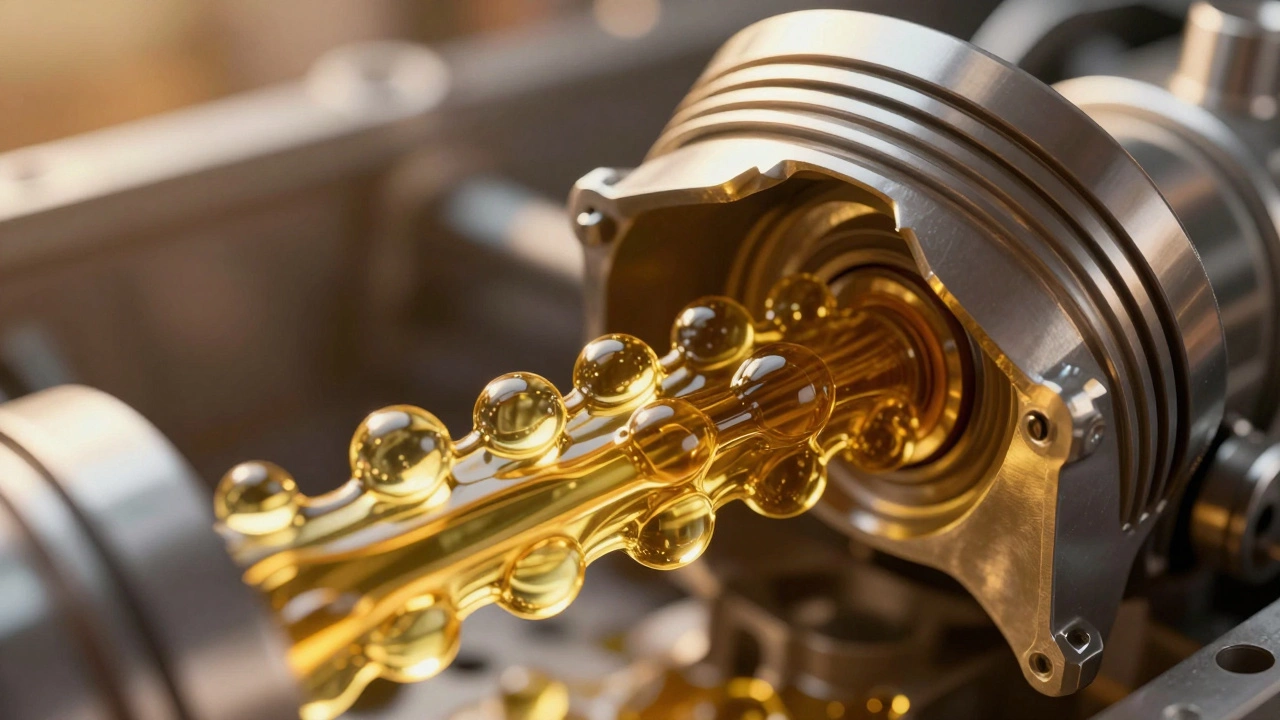
Comparison: Which Oil Fits Your Needs?
| Feature | Conventional Oil | Synthetic Blend | Full Synthetic |
|---|---|---|---|
| Base Composition | Refined crude petroleum | Mix of conventional & synthetic | Chemically engineered molecules |
| Best For | Older cars, light duty, budget-conscious drivers | Towing, moderate performance, mid-range budgets | New cars, turbo engines, extreme temps, high mileage |
| Change Interval | 3,000 - 5,000 miles | 5,000 - 7,500 miles | 7,500 - 15,000 miles |
| Cold Weather Performance | Poor (thickens quickly) | Moderate | Excellent (flows instantly) |
| Cost Per Quart | $\$ | $\$\$ | $\$\$\$ |
Common Misconceptions About Engine Oil Types
There’s a lot of noise in the automotive world, especially online forums and mechanic shops. One persistent myth is that synthetic oil causes leaks in older engines. This is largely false. Synthetic oil is cleaner and better at dissolving old sludge, which can sometimes dislodge debris that was plugging up small gaps. If your engine already had impending leaks due to age, synthetic oil might reveal them sooner, but it didn’t cause the leak. The seal degradation was already happening.
Another misconception is that you can mix any type of oil together in an emergency. Technically, yes, you can top off synthetic with conventional or vice versa if you run dry. They won’t explode or ruin your engine immediately. However, mixing them dilutes the benefits. If you’re running full synthetic and add conventional oil, you’ve essentially turned your premium lubricant into a synthetic blend. Do it once in a pinch, but switch back to the correct type at your next scheduled change.
People also confuse viscosity with type. Viscosity (like 5W-30 or 0W-20) refers to thickness, while type refers to composition. You can have conventional 5W-30 and synthetic 5W-30. Always follow the viscosity recommended in your owner’s manual, but choose the type based on your engine’s age, performance needs, and budget.

Special Considerations: High Mileage and Electric Vehicles
While the three main types cover most scenarios, two emerging categories deserve mention. First, High mileage oil is typically a full synthetic or synthetic blend formulated with extra seal conditioners and anti-wear additives for engines with over 75,000 miles. These oils help rejuvenate aging seals to prevent leaks and reduce burn-off. If your car has high kilometers, switching to a high-mileage variant of your preferred type (usually synthetic) is a smart move.
Second, with the rise of electric vehicles (EVs), traditional engine oil becomes irrelevant for the motor itself. However, EVs still have transmission fluids and differential oils. Some hybrid models also require specific synthetic blends for their internal combustion engines, which operate intermittently. As we move through 2026, understanding that "engine oil" applies primarily to combustion engines is crucial. If you drive a pure EV, you don’t need any of the three types discussed here for propulsion, though you may need specialized gear lubricants.
How to Choose the Right Oil for Your Car
So, how do you decide? Start with your owner’s manual. It is the legal contract between you and the manufacturer regarding maintenance. If it says "Synthetic Required," do not use conventional. Doing so could void your warranty. If it says "Conventional Recommended," you can safely use synthetic as an upgrade, but you aren’t forced to.
Consider your driving habits. Do you mostly cruise on highways? Synthetic lasts longer and protects better at sustained high RPMs. Do you sit in traffic jams in Adelaide’s peak hour? Stop-and-go driving creates more heat cycles and contamination, favoring synthetic’s stability. Do you tow a caravan? The added load stresses the engine, making synthetic blend or full synthetic a wise investment to prevent overheating and wear.
Finally, look at your budget. Calculate the cost per mile, not just the cost per bottle. A $40 bottle of synthetic that lasts 10,000 miles is cheaper per mile than a $20 bottle of conventional that needs changing every 5,000 miles, especially when you factor in labor costs for oil changes. Over five years, the math usually favors synthetic for most modern drivers.
Can I switch from conventional to synthetic oil?
Yes, you can switch from conventional to synthetic oil at any time. There is no need to flush your engine beforehand unless it has significant sludge buildup. Just drain the old oil, replace the filter, and fill with the new synthetic oil. Many mechanics recommend this upgrade for older cars to improve protection and extend engine life.
Is synthetic oil worth it for an older car?
It depends on the condition of the engine. If your older car runs well and has no major leaks, synthetic oil can help clean out deposits and provide better protection against wear. However, if the engine is very worn or has existing seal issues, consult a mechanic first. Sometimes, conventional oil’s slightly thicker nature helps mask minor wear in ancient engines, though modern synthetics are generally safe for most pre-2000 vehicles.
What does the 'W' in 5W-30 mean?
The 'W' stands for Winter. The number before the W (e.g., 5W) indicates the oil's viscosity at cold temperatures. A lower number means the oil flows more easily when cold, which is crucial for starting your engine in freezing weather. The number after the W (e.g., 30) represents the viscosity at operating temperature. This rating ensures the oil provides adequate protection whether you're starting up in the morning or cruising at highway speeds.
How often should I change my engine oil?
This varies by oil type and vehicle. Conventional oil typically needs changing every 3,000 to 5,000 miles. Synthetic blends can go 5,000 to 7,500 miles. Full synthetic oil can last 7,500 to 15,000 miles. Always check your vehicle’s owner manual for the manufacturer’s specific recommendation, as severe driving conditions (towing, extreme heat, frequent short trips) may require more frequent changes regardless of oil type.
Does synthetic oil last longer than conventional?
Yes, synthetic oil lasts significantly longer because it is more resistant to thermal breakdown and oxidation. Its uniform molecular structure prevents it from thinning out or forming sludge as quickly as conventional oil. This allows for extended drain intervals, reducing the frequency of oil changes and potentially saving money on labor over time.