How Long Does It Take to Replace a Car Radiator? - Hours Explained
Find out exactly how many hours a radiator swap takes, whether you do it yourself or visit a garage, with step‑by‑step timings, tools, and cost tips.
View moreWhen your engine starts running hot or you notice puddles under your car, the radiator, the main component that cools engine coolant by transferring heat to the air. Also known as a cooling radiator, it’s one of the most critical parts of your car’s cooling system. Without it, your engine overheats fast—sometimes in minutes—and that’s when expensive damage starts. Replacing a radiator isn’t just about swapping a metal box; it’s about keeping your whole engine alive.
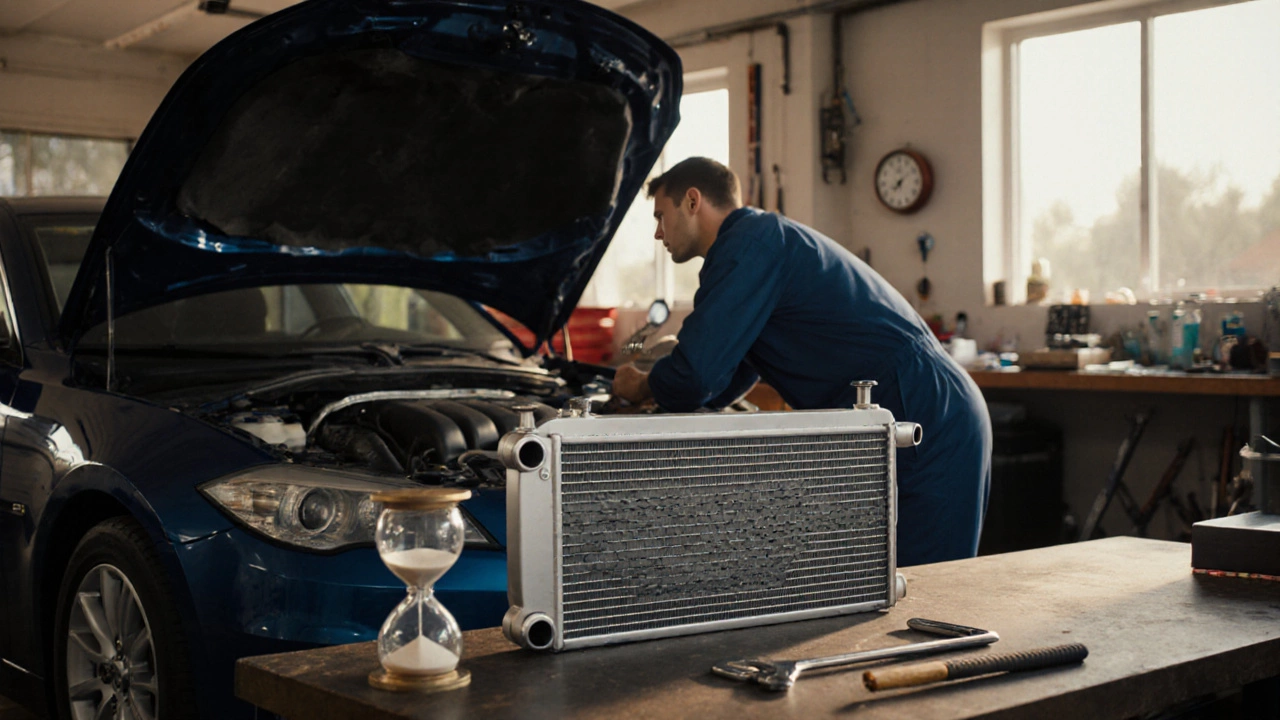
Most people think replacing a radiator takes all day, but the truth? It usually takes 2 to 4 hours for a skilled mechanic, depending on the car. Some models, like older Hondas or Toyotas, are easy—radiator access is simple, and hoses are easy to disconnect. Others, like newer BMWs or SUVs with tight engine bays, can take 5 hours or more because you have to remove the bumper, cooling fans, or even the AC condenser just to get to it. If you’re doing it yourself, add another hour or two for learning curves and mistakes. Don’t forget to factor in draining and refilling coolant, bleeding air from the system, and checking for leaks after it’s done. A bad job here means overheating again, and that’s a waste of time and money.
Here’s what often gets missed: when the radiator fails, other parts are usually worn out too. The radiator hoses get brittle with age. The thermostat might be stuck closed. The water pump could be leaking or noisy. And if coolant has been dirty for years, the heater core might be clogged. That’s why most mechanics recommend replacing the thermostat and flushing the coolant at the same time. It’s cheaper than doing it twice. And if your car has over 100,000 miles, consider upgrading to a high-performance aluminum radiator—it lasts longer and cools better than the stock plastic-and-aluminum version.
Signs you need a replacement? Overheating on short drives, coolant smells inside the cabin, visible cracks or bulges on the radiator tank, or green, orange, or red fluid leaking under the car. Don’t wait for steam to come out of the hood. That’s already too late. Even a small leak can turn into a blown head gasket, and those repairs cost three times as much as a radiator swap.
What you’ll find in the posts below are real-world guides on fixing cooling system problems—not just radiators, but everything connected to them. From how to test a thermostat without removing it, to why your car overheats only in traffic, to what coolant type your specific model actually needs. No theory. No fluff. Just what works on the road, in the driveway, and in your wallet.
Find out exactly how many hours a radiator swap takes, whether you do it yourself or visit a garage, with step‑by‑step timings, tools, and cost tips.
View more