Engine Oil Selector Tool
Car / SUV
Small Engine
Lawnmower/ChainsawRecommended Specification
Viscosity Grade: --
This number indicates thickness at cold and hot temperatures.
API Standard: --
Look for this donut symbol on the bottle.
Checklist Before Buying:
- ✅ Check owner's manual first
- ✅ Match viscosity grade exactly
- ✅ Verify API certification logo
- ✅ Buy from reputable retailer
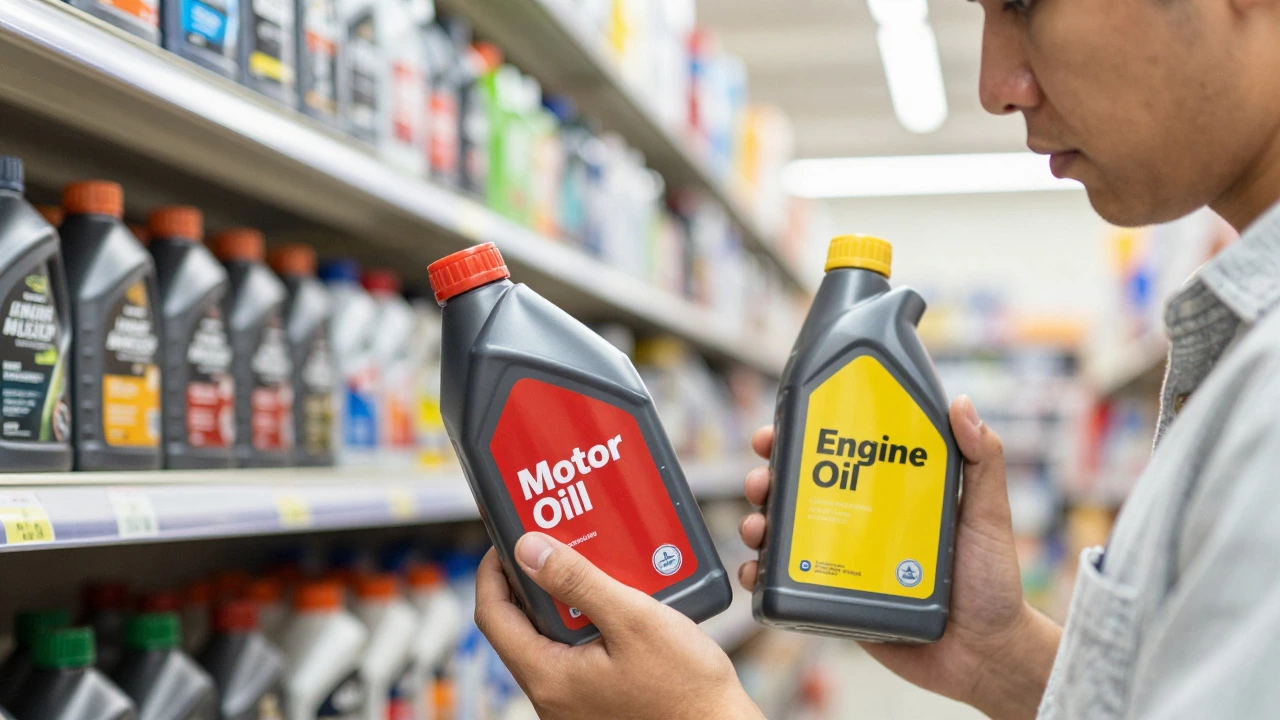
You’ve probably stood in the automotive aisle at a hardware store or supermarket, staring at bright yellow and red bottles. One says "Motor Oil" in big bold letters. Another right next to it says "Engine Oil." You pause. Are they different? Do you need a special one for your car versus your lawnmower? Is there a secret chemical formula hidden behind that label swap?
Here is the short answer: There is no difference.
It sounds like a trick question, but it’s true. Engine oil and motor oil are exactly the same product. They share the same base ingredients, the same additives, and serve the exact same purpose. If you buy a bottle labeled "motor oil," you can pour it into any internal combustion engine without worry. If you buy "engine oil," it works just as well.
The Marketing Myth of Two Oils
So why do we have two names for the same thing? It comes down to marketing history and consumer psychology. In the early days of automobiles, the term "motor oil" was more common because "motor" was the standard word for the engine itself (think "electric motor" vs "combustion engine"). As time went on, manufacturers realized that saying "engine oil" sounded more technical and specific to cars, while "motor oil" felt broader, covering everything from motorcycles to outboard boat motors.
Brands started using both terms interchangeably to capture different segments of shoppers. Some brands leaned heavily into "motor oil" to appeal to DIY mechanics who work on small engines like chainsaws and generators. Others used "engine oil" to target car owners looking for high-performance synthetic blends. But look closely at the fine print on those bottles. You’ll see the same API service categories, the same SAE viscosity grades, and often the same manufacturer producing both labels under different brand umbrellas.
This isn’t unique to oil. We see this with other products too-like how "diet soda" and "sugar-free soda" are often the same drink, just packaged differently to hit different shopper mindsets. With oil, however, the confusion can lead to unnecessary anxiety when you’re trying to maintain your vehicle.
What Actually Matters: Viscosity and Standards
If the name on the bottle doesn’t matter, what does? You need to focus on three things: viscosity grade, performance standards, and application type. These are the real factors that determine whether an oil will protect your engine or destroy it.
Viscosity is a measure of a fluid's resistance to flow. Think of it like honey versus water. Honey has high viscosity; it flows slowly. Water has low viscosity; it flows quickly. Engine oil needs to be thick enough to create a protective film between moving metal parts, but thin enough to circulate rapidly when the engine starts cold.
You’ll see numbers like 5W-30 or 10W-40 on every bottle. That first number (before the W) tells you how the oil behaves in winter (cold temperatures). The lower the number, the easier it flows when it’s freezing outside. The second number tells you how thick the oil stays at operating temperature (around 100°C). A 30-weight oil is thinner than a 40-weight oil. Using the wrong viscosity can cause poor lubrication during startup or excessive friction when hot.
Next, look for the API donut symbol. This circular logo shows the performance level approved by the American Petroleum Institute. For gasoline engines, you want something like API SP or SN Plus. For diesel engines, look for CK-4 or FA-4. These codes tell you the oil meets specific tests for wear protection, sludge prevention, and emissions system compatibility. Ignoring these standards is where people actually make mistakes-not by picking "motor" over "engine" oil.
| Attribute | Why It Matters | Common Values |
|---|---|---|
| Viscosity Grade | Determines flow in cold weather and thickness at operating temp | 5W-30, 0W-20, 10W-40 |
| API Service Category | Ensures oil meets industry standards for wear and cleanliness | SP, SN Plus, CJ-4, CK-4 |
| Base Oil Type | Affects stability, longevity, and extreme temperature performance | Synthetic, Synthetic Blend, Conventional |
| Additive Package | Provides detergents, dispersants, anti-wear agents | ZDDP, MoDTC, Calcium Sulfonate |
Synthetic vs. Conventional: The Real Divide
While "engine" vs "motor" is a myth, the split between synthetic and conventional oil is very real. This is where your choice actually impacts your wallet and your engine’s lifespan.
Synthetic oil is man-made lubricant engineered from refined petroleum chemicals. Unlike conventional oil, which is simply filtered crude oil, synthetic oil is chemically structured to have uniform molecules. This means fewer impurities, better heat resistance, and less breakdown over time.
In Australia, where summer temperatures in Adelaide can push past 40°C, synthetic oil holds its structure much better than conventional oil. It won’t thin out as dramatically under heat stress. It also flows better in winter mornings, reducing wear during those critical first few seconds after you turn the key.
Conventional oil is cheaper upfront, yes. But if you drive long distances, tow heavy loads, or live in extreme climates, synthetic pays for itself by extending drain intervals and protecting against sludge buildup. Most modern cars built since 2015 come filled with synthetic or synthetic blend oil from the factory. Sticking with that recommendation is usually the safest bet.

Small Engines vs. Car Engines: Where Confusion Starts
Here’s where the "motor oil" label gets tricky. People often associate "motor oil" with small engines-lawnmowers, leaf blowers, chainsaws, and portable generators. And while you *can* use car engine oil in many of these machines, it’s not always ideal.
Car engine oils contain detergent additives designed to keep large engines clean over thousands of miles. Small engines, especially air-cooled ones like lawnmowers, run hotter and lack complex filtration systems. High-detergent car oils can sometimes leave residues in small carburetors or exhaust ports. That’s why many small-engine manufacturers recommend oils specifically formulated for them-often labeled as "small engine oil" or meeting JASO MA/MA2 standards for wet-clutch motorcycles.
However, if you’re in a pinch and only have 10W-30 car oil, pouring it into your lawnmower won’t kill it immediately. Just don’t expect it to last as long, and consider switching to a dedicated small-engine oil for regular maintenance. The key takeaway? Don’t let the word "motor" fool you into thinking it’s inherently better for small engines. Look for the specific application notes instead.
How to Choose the Right Oil for Your Vehicle
Forget the name on the front. Follow this simple checklist to pick the right oil:
- Check your owner’s manual. This is non-negotiable. Your manufacturer tested their engine with specific viscosities and performance levels. Deviating without good reason risks warranty issues.
- Note the viscosity grade. Write down the recommended weight (e.g., 5W-30). Stick to it unless you have a compelling reason to change (like an older high-mileage engine needing thicker oil).
- Look for the API certification. Ensure the oil meets or exceeds the API service category listed in your manual. Newer cars require newer standards like API SP.
- Consider your driving conditions. Do you mostly city-drive with frequent stop-and-go traffic? Or do you highway-cruise? Severe service conditions may benefit from full synthetic oil even if conventional is allowed.
- Ignore the marketing buzzwords. Terms like "ultra-premium," "advanced technology," or "maximum protection" are fluff. Focus on the specs printed on the side panel.
If you follow these steps, you’ll never again waste time wondering if "motor oil" is different from "engine oil." You’ll know exactly what matters-and what doesn’t.

Common Mistakes to Avoid
Even experienced drivers make silly errors when buying oil. Here are the most common pitfalls:
Mixing brands randomly. While mixing different brands isn’t catastrophic, it’s best to stick with one formulation consistently. Different additive packages can interact unpredictably, potentially reducing effectiveness. Pick a reliable brand and stay with it.
Ignoring oil life monitors. Modern vehicles have sensors that track engine temperature, RPM, and driving patterns to calculate optimal oil change intervals. Relying solely on mileage (like "every 5,000 km") ignores actual usage. Trust your car’s computer-it knows better than a generic schedule.
Using multi-grade oil incorrectly. Some people think 10W-40 is "better" than 5W-30 because it’s thicker. Not true. Thicker oil doesn’t mean more protection-it means more drag on moving parts, which reduces fuel efficiency and increases heat. Use what your manual specifies.
Buying cheap no-name oils. Discount bins at auto parts stores often hold old stock or questionable brands. Oil degrades over time, even unopened. Buy from reputable retailers and check production dates if possible. Fresh oil performs significantly better than oil sitting on a shelf for two years.
Environmental Considerations
Oil disposal is another area where knowledge matters. Used oil contains heavy metals and toxic contaminants from combustion. Pouring it down the drain or onto the ground pollutes soil and waterways. In South Australia, recycling programs exist through local council facilities and major auto parts chains.
When changing your own oil, collect all drained fluid in a sealed container. Take it to a designated drop-off point. Many garages accept free used oil returns. Proper disposal protects ecosystems and ensures recycled oil can be re-refined into new lubricants-a sustainable cycle that benefits everyone.
Choosing eco-friendly oil options is also becoming easier. Biodegradable synthetic esters are available for marine applications and sensitive environments. While pricier, they break down faster in nature if accidental spills occur. For everyday car use, sticking to high-quality synthetic oil minimizes consumption and extends drain intervals, indirectly reducing environmental impact.
Is motor oil the same as engine oil?
Yes, completely. The terms are interchangeable marketing labels for the exact same product. Both refer to lubricants designed for internal combustion engines. There is no chemical or functional difference between them.
Can I use car engine oil in my lawnmower?
You can, but it’s not ideal. Car oils contain detergents that may leave deposits in small air-cooled engines. For best results, use oil specifically formulated for small engines or labeled for lawn equipment. If you must use car oil temporarily, choose a single-grade mineral oil like SAE 30 rather than a multi-grade synthetic.
Does synthetic oil last longer than conventional oil?
Generally, yes. Synthetic oil resists thermal breakdown and oxidation better than conventional oil, allowing for extended drain intervals-often up to 15,000-20,000 kilometers compared to 5,000-8,000 for conventional. Always verify with your vehicle manufacturer’s recommendations.
What does 5W-30 mean on an oil bottle?
The "5W" indicates the oil’s viscosity at cold temperatures (Winter rating), meaning it flows easily down to -30°C. The "30" refers to its viscosity at operating temperature (100°C). Lower numbers mean thinner oil; higher numbers mean thicker oil. This dual-rating allows smooth cold starts and adequate protection when hot.
Should I change my oil based on mileage or time?
Both matter. Oil degrades over time due to moisture absorption and additive depletion, even if you don’t drive much. Most manufacturers recommend changing oil every 6-12 months or at specified mileage intervals, whichever comes first. Modern oil life monitoring systems provide personalized guidance based on actual driving conditions.